This photo may look funny but it is of a small cluster of seeds off of our cottonwood trees that are so common here in New Mexico. There are very tiny seeds in the 'cotton'. The cotton is so light it 'flies' everywhere after the trees have their almost un-noticeable flowers on the female trees. The male trees do have a sort of flower that is needed to pollinate the female flowers but they don't have the cotton with their flowers. Most of the hybrid cottonwood trees that are sold in plant nurseries and non-flowering as most people don't want the mess of the cotton in their yards.
Only those who have the patience to do simple things perfectly ever acquire the skill to do difficult things easily. (Friedrich Schiller , German Dramatist and poet)
Friday, July 31, 2009
Cottonwood Cotton
This photo may look funny but it is of a small cluster of seeds off of our cottonwood trees that are so common here in New Mexico. There are very tiny seeds in the 'cotton'. The cotton is so light it 'flies' everywhere after the trees have their almost un-noticeable flowers on the female trees. The male trees do have a sort of flower that is needed to pollinate the female flowers but they don't have the cotton with their flowers. Most of the hybrid cottonwood trees that are sold in plant nurseries and non-flowering as most people don't want the mess of the cotton in their yards.
Wednesday, July 29, 2009
The Jackson Visitor Center finally closes its doors
Without too much fanfare, the Jackson Visitor Center closed its doors to the public today, September 28th, . The NPS is replacing the facility with a new Jackson Visitor Center, scheduled to open (with much fanfare) on October 10th.For curiosity and fun, I hung out near the main doorway as the final visitors exited and walked away. Over the past two weeks, a public reader board noted today’s significance by counting down the days. Next to it was a hand drawn picture of the space saucer shaped visitor center blasting off into orbit above Mount Rainier. As the front doors were finally locked, you could see rangers and concession employees giggling and smiling inside.
Before the doors closed, I spoke with about one dozen visitors. Interestingly, most didn’t know before arriving in the park that today was the Jackson Visitor Center’s “last day.” Those who did primarily lamented the loss of the 360 degree view from the observation deck, and why wouldn’t they? Today was perfect and the sun was showing off as it slowly slipped behind the mountains and down the Nisqually Valley. The day had been clear and surprisingly warm for late September.
A small crowd cheered as the family (above and left) was informally proclaimed “the last visitors to the JVC.” By the way, there is nothing official about this distinction. It’s just that the doors were promptly locked behind them as they left. Turns out, they were from Puyallup and cruised up in a restored 1969 Cougar to say goodbye. Here is TNT reporter Jeff Mayor talking with them. Note the smiles.Anyway, now we're just wondering: what sort of welcoming will the new JVC get? More after October 10th.
Monday, July 27, 2009
Gunks Routes: Commando Rave (5.9) & Dat-Mantel (5.10b)
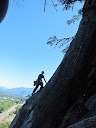
(Photo: Maryana starting the crux section of Commando Rave (5.9).)
Last Sunday was a gorgeous day, with highs in the mid- to-upper sixties. In other words: sending weather. High season, baby!
I was meeting up with Maryana for the first time in a while. She had been forced to take an eight-week break from climbing because of a cycling accident in the city, which had left her with several fractures in her back. This was a heartbreaking blow for her, coming as it did right in the middle of a great climbing year. Before the accident Maryana had led some truly impressive Gunks 5.10's (like Birdcage, for example). But now she had to rebuild. I was climbing with her on only her second weekend back in the climbing game.
We started with a nice warm-up. I led both pitches of Son of Bitchy Virgin (5.6) in one, running it all the way to the GT ledge. I'd never done the first pitch before. It is okay, but after the initial 5.5 overhang there isn't really much to recommend it. I think the second pitch is quite nice, but it is better approached via the Immaculate Conception variation.
After our warm-up Maryana did an excellent job leading Dry Heaves, a challenging 5.8. Then I got down to business with one of those 5.9's I still hadn't gotten around to: Commando Rave.
Dick Williams suggests in his guide book that Commando Rave is a polarizing climb. He says some love it and some hate it. I guess the hate springs from the lack of pro before the crux. The climb begins with some nice moves up a seam. Then comes an unprotected thirty-foot (!) traverse, but really this traverse is so easy it is barely fifth class. For most of it you are basically walking on a sidewalk. And about two-thirds of the way across I actually got a big blue Camalot in the crack at my feet. After that the rest of the way was well-protected.
The crux is really fun. You angle up and right through some overhangs to a left-facing corner. The hardest bit comes as you reach the end of the roof at the corner. You have to hang in to place a bomber piece, and then it takes a balance move out right to escape the corner and reach up to the good hold.
Once through the crux the belay tree is just a couple of moves away. Commando Rave is good, featuring a solid 5.9 crux. It is a quality quick tick, and totally worth doing. It isn't amazing, and it certainly isn't bad. I really can't imagine loving or hating it.
(Photo: Heading up to the big roof on Dat-Mantel (5.10b).)
I felt pretty good about Commando Rave, and afterwards thought I might get another quick tick, this time of a 5.10. I jumped right on the nearby Dat-Mantel.
This was a climb I'd aborted leading with Gail. On that occasion I was just getting up to the roof when I realized I needed some big gear I'd already used below, and then it started raining. After abandoning the lead I sent it pretty easily on toprope on the first try. Pissed to have found it so easy, I resolved then to try to come back and get the redpoint on lead before was out.
(Photo: Getting ready to attack the roof on Dat-Mantel.)
This time, on lead, I wouldn't say it went easily, exactly. I fumbled about a bit before figuring out how to reach the bomber horizontal above the roof. Then I was psyched to place two good cams above the roof, one for each of our double ropes.
I got set to throw a heel and pivot over the roof....
And it worked out. It took a few tries. It wasn't pretty. I remember standing right up over the roof when I did it on top rope. On lead, by contrast, I ended up basically pushing my whole leg and hip into the rock before I could pull myself over the roof. But I never weighted the rope, and I made it! I'll gladly call it a victory and put it in the bank.
Dat-Mantel is a good introductory 5.10. The crux is short and the pro is great. You should be careful as you figure out how to reach the horizontal over the roof. There is good pro at the back, where the roof meets the wall, but until you can plug that horizontal over your head a fall will send you down onto the slab.It wouldn't bea dangerous fall, but it would be unpleasant. Once you get your fingers in the horizontal, however,there are great placements left and right, and you can try the roof move over and over again without falling onto the rope.
After Dat-Mantel my day was as good as done. With a new 5.9 onsight to my credit plus a successful 5.10, I was content to coast. Maryana proved herself to be the comeback kid, leading two more hard 5.8's: the wonderful first pitches of both Carbs & Caffeine and Airy Aria. I then got to end our day by combining the beautiful second and third pitches of Airy Aria into one lead, a fitting finish to a glorious day of climbing.
I love sending season.
Saturday, July 25, 2009
Foggy Sunrise in the Pigeon River Valley
Can you say.... W O W !!!!!!!!!! ? This was the scene I witnessedMonday morning after spending the entire night photographing the northern lights. I had noticed the fog along the river earlier in the night and decided to come back to this location for sunrise. It proved to be a worthwhile decision. As the sun rose over the hills and the light hit the fog in the valley, the colors and layers between fog and trees were breathtaking. This was photographed from the Pigeon River Helipad and Overlook along Otter Lake Road in Northeast Minnesota.
Thursday, July 23, 2009
I Never Asked for a Honeymoon
When it comes to new bike ownership, cyclists will often talk about the so-called honeymoon phase. Symptoms include: lack of interest in looking at other bikes, thinking that everything about the new bike is "perfect," even finding its flaws endearing. It's more than about enjoying the bike. It's like being under its spell. Some describe this as the magic faerie dust effect.
In the past, I don't think that I've gone through honeymoon phases with my bikesexactly. I am by nature analytical and tend to see things from several perspectives at once. Even in the beginning, when I was extremely excited about my first beautiful new bike, I was all the while looking at it critically. Its purchase did not diminish my curiosity about other bikes in its category, but increased it. It was in fact through comparing other bikes to mine and noticing differences, that I became interested in bicycle design. The same can be said for all of my bicycle buying and selling since: There was excitement and enjoyment, but never really a rose coloured glasses type honeymoon period. It was more about experimenting and staying open to other possibilities. Considering my interest in bicycle reviews, design, framebuilding and such, I think this is a useful attitude to have.
So it has thrown me for a loop to realise that maybe, just maybe I am in a prolongued honeymoon phase with my Seven roadbike, which I've been riding since Spring of this year. The symptoms are there: Everything about it feels "perfect." The fact that it's welded and has a carbon fork somehow only accentuates its charm, even as I wax lyrical about lugs. And more disturbingly, I have lost interest in other bikes in its category. This last part is a problem! I would like, in theory to keep trying other roadbikes and comparing them, thereby learning more about the feel of different frame materials and different handling characteristics. But in practice, I don't really want to ride bikes other than my own just yet. If it's a different style of bike for different kinds of riding, I am as enthusiastic about experimenting as ever. But for roadcycling on pavement, I would rather be on my own bike. It's as if I haven't had enough of it yet, even after 2,000 miles. The decals are peeling, but the proverbial luster apparently remains. I hope to get over this soon. Until then, you are unlikely to see much in the way of roadbike test-rides here.
Have you gone through a honeymoon phase with any of your bikes? What has it been like, and what happens afterwards?
Monday, July 20, 2009
Three Days in Squamish ..
Sabrina and I teamed up for three days in Squamish. We had big plans. There was talk on the drive up about Diedre, Calculus Crack, Snake and St. Vitus. We even discussed The Ultimate Everything. Could these all be done in two and half days? We were about to find out.
Day 1:
In the car we eventually decided to hit Shannon Falls on the first day. We figured trying to get on busy apron climbs on a Saturday late in the morning was not going to benefit us in our time use equation and opted for Shannon Falls. After a quick stop to set up camp (the last tent site!) we got rolling south to Shannon Falls.
Our objective there was the new route Skywalker. A mellow 5.8 multi pitch route that would be good for us to do as our intro to the weekend. We hiked quickly up to the base to get in the queue. There was a second leaving the ground, and a party of two ahead of us. We geared up while we waited. Three parties of two arrived shortly afterward. This is a very popular climb.
Finally it was our turn, and I waited for the party ahead of us to get to the belay before I started out. The first moves were a touch tricky with a seeping corner where I wanted to place a foot. Eventually I succumbed to putting a foot in the wet corner to make the crux move of the pitch and continue up. There was then a move leaving the crack to traverse the slab to where the crack continues and up I went to a tree belay. (The party ahead of us was currently occupying both bolted anchors. ) I brought Sabrina up in time for her to head up the next pitch behind their second.
The next pitch was a 5.8 corner that was a little compressed, but offered great climbing and good pro opportunities. I found it a little rough on my right foot as I continuously wedged it into the corner/crack. But it was a nice pitch. I got the next pitch which followed some cracks up to a heady move right before the next belay. Gear was good until that point, but sort of disappeared in the last ten feet or so. I made the moves and brought Sabrina up.
The next pitch(4) is where the route gets its name. It is the Skywalker Traverse. One of the bolts at the belay actually says "May the Force be with You." It is a really easy, somewhat exposed traverse. It is slabby and can be done with counter pressure with hands in the crack at the base of the wall above it, but I walked it for the most part with my hand on the wall.
The final pitch was a short easy bolted slab that I ran up and brought Sabrina to the top. This route was an excellent warm up for us, and a pretty nice route for the grade.
We walked off and headed to the Klahanie Crack area. There was of course a line for that route as well and we waited for a couple to get off of Dirty Dickie before we attempted to climb it. Sabrina led it and I followed, finding the wide section near the top to be the crux. We rapped, and then Klahanie Crack was available. Sabrina racked up for it, and headed off on the sharp end. She was placing a lot of gear due to it being late in the day and her energy level. This caused concern about having enough gear to finish the pitch. Her feet were sore from jamming the crack and she hung a few times to cool them off. Once at the top she brought me up and we rapped. With our feet worn out, we did not even bother with Cardu Crack. Maybe next time. A cool soak of our feet in Shannon Creek did the trick before we returned to our camp site.
Day 2:
We had big ambitions of climbing a new route, the North Face variation of Squamish Buttress, aka Squamish Buttface. Our approach climb was to be Snake on the apron. Definitely not the fastest way up to the South Gully, but one we thought capable of doing. The alarm went off at 5am and we both felt a little tired from the previous day to wake up at that point. So we slept in until about 6am. It was at least a few more hours before we were able to leave the campground and walk to the base of the route.
Even though the first pitch is 5th class, it appears the guide book either wants you to scramble the pitch, or simply does not count it in the pitch total. We roped up for it and ended up climbing two short pitches to reach the ledge where Snake starts. Since I led the approach pitches, Sabrina took the lead on the first pitch, which starts the right facing corner climbing. Before she left, we discussed if she would do the unprotected 5.7 traverse or head up to the tree leaving me to the traverse. She told me she might, but would probably end up at the tree. Which is where
she ended the pitch and brought me up to. I led out for the 5.7 traverse, and was not happy with the lack of protection. I was able to sling a horn, but botching the moves on the traverse would have led to a decent pendulum. I balked numerous times attempting the traverse high until I somehow noticed a really good foot hold low and down climbed a few moves to make the traverse from there. Once on the low path, I made quick work of the traverse and was at the bolts on the other side, bringing Sabrina in.
The next pitch was lightly protected 5.9 traverse, so I got that one too. It started out on easy ledges and ramps to a good sized ledge with a not so good sized bush. There are two variations that follow: one that continues left on a unprotected slabby traverse of a dyke, or another that heads up a slab with a 2" corner moving left once you gain some ledges. Both options were 5.9. I placed a cam at my feet and went left. There was a large hand pocket about two thirds of the way, but I couldn't reach it and came back. I looked up. It appeared promising. There was a small pocket in the corner where I got at least three lobes of a blue alien. I was going up. By placing the cam I negated the first hand hold on that section but made do with what I got until I got the second hand hold and kept it until I could reach the ledges above. On safer ground, I slung a horn and headed to the belay tree. I brought Sabrina up as she thanked me for leading the sketchy slab.
Sabrina got the next pitch and headed up the long right facing corner. There was a steeper section early on, but the crux came close to the next bolted anchor. I quickly followed as Daryl and Luke from the previous day were now on our tails. I offered them to pass at the next belay, but Daryl was only about a quarter up the pitch when I arrived at Sabrina's location. So I quickly headed out thinking we could stay ahead of them. This was proving true as I dispatched the first half of the pitch quickly. There were few pro opportunities, which kept me moving quickly. The lay backing of the corner was a touch strenuous, and moving kept it more manageable. Then I came up on the crux. There were some thin moves up a flake before gaining a ledge at the base of a large wall. A traverse back right overcomes the wall, but not without going through the crux first.
I got to the ledge and slung some roots. Moving further, I removed the sling and placed it on the tree in the middle of the traverse. For some reason I had my feet really high and they were getting tired. I placed a cam in a pocket a few feet from the tree. I tried to move right, but couldn't figure out the moves. My feet were getting tired. I hung. My foot slipped while hanging. There was a patch of slick damp rock from a seep and my foot must have got in it. I dried it a bit. I attempted again. No luck, I was hanging again. But this time I dropped my feet. All I have to do is climb it like a slab, and not rely on my hands so much I thought. I tried again. But it still couldn't make the move. Then I finally shortened the draw on the cam and was able to make the move and zip around the corner to the next belay. I brought Sabrina up and she quickly moved on to the final 5.7 pitch and then we scrambled up to Broadway for a lunch.
During our lunch break we discussed our slowness and tiredness. We also discussed which route we should take to reach Squamish Buttress. There were four people lined up at Memorial Crack and we had moved slow to this point. It was later in the day than we wanted, and I offered a suggestion to Sabrina that we head down and perhaps try another route on the apron and shoot for Squamish Buttress the following day. On the way down we were once again fairly slow and chatted a bit with other Seattle climbers on the trail. We then chatted a bit with Luke and Daryl before heading down. It was now 4:30pm and I recommended to Sabrina we call it a day.
Day 3:
We awoke tired again, but we were motivated and got out of the tent quicker and started our day. We left the campground at least an hour earlier than the previous day and hoped to do Diedre as our apron route. Upon arriving at Diedre, there was one party climbing and another waiting. We opted to take Banana Peel to the top as it also would deposit us at the base of Boomstick Crack. Sabrina led up to the crack and started the traverse. When the rope ran out, I simul climbed until I reached her at the base of the first real pitch. She led again which gave me the crux pitch of the route. I almost passed the bolt on the way to a .10b bolt before Sabrina caught me and directed me in the right path. I went through the crux moves, and brought Sabrina up. We danced up the rest of the pitches and took a snack break on Broadway before tackling Boomstick Crack.
Sabrina balked at the opening crux moves, but I wouldn't succumb to her pleas of leading it. She got the moves and made quick work of the rest of the pitch. I climbed up to her and dispatched the remaining bit before untying in the woods. We kept our rock shoes on and scrambled up to the base of Squamish Buttress. We stopped for a bit in the forest to have lunch and then arrived at the base.
I took the first lead. But we allowed a quicker team to go first before I left the ground. That was pretty much the last we saw of them. The opening moves of the first pitch are easy gaining a roof, but then there are some thin moves to a bolt, and then even thinner moves above the bolt, the crux of the pitch. I took a bit to unlock the moves and then I was on my way. I combined the first two pitches and it got progressively easier as I went. However the protection opportunities were pretty scarce most of the way. I arrived at a tree belay and Sabrina soon joined me. She ran up around the corner to the next bit, and I followed. I set a belay and she led the next two pitches as one. These pitches were awkward bits with a few pro opportunities to protect them.
Once arriving at the belay, I poked around the corner to find the start of the North Face
Variation. I found it, and Sabrina joined me. It was steeper than I imagined, but was completely doable by our party. I wanted to lead this 5.9 pitch as I wasn't too excited about the other one. But I often get spooked by steep climbing and had to work myself up to it. I took the rack and led off. A few pieces up and I was pumping and down climbed back to the base. I looked at the moves again and gave it another go. An adjustment of my top piece and my mindset, and I was higher and placing another piece. A few moves later I placed another piece and then it was up to a bolt. From the ground it looked as though the climbing got easier at the bolts, by this was untrue. A few moves leftward the climbing eased a bit and I gained the ledge. The remaining portion of the pitch was awesomely exposed climbing up steps on the ledge. It was amazing how quickly the gully floor dropped away after the short steep section. I belayed Sabrina up enjoying Ravens flying below me and the tops of trees down in the South Gully.
Since she was leading the next 5.9 pitch, I led the short bit to the tree and brought her over. I laughed when I saw the gaping maw that was the next pitch. She joined me and was startled by the look of it. She expressed her concern about leading it. I told her I would if she wanted me to. She did. We reflaked the rope and I headed off. This was supposedly the last 5th class pitch before reaching the top, but it was a considerable looking obstacle between us and the easier
ground. I placed a nut and made the mantle move into the bottom of the scoop. I got a small suspect cam in between flakes near my feet and then entered the hole to place a blue alien in the back. I made a few moves and then placed a cam higher. I climbed back down as I was getting pumped and not unlocking the problem. I went up again with a better strategy and got higher, placing yet another cam in the deep back. I found a pocket in the back for a finger and I used holds on the arete with my right hand and foot. But trying to chimney the moves was proving difficult for me at best.
Was I in too deep? Were my long legs not suitable for the size of the crack? I felt I had to succeed as to not spend the night on the ledge. I moved up and was able to place the #1 cam listed on the topo. I was now in reach of the flake on the wall and grabbed it with my left hand. Now I had to turn my hip toward the wall. What to do with my right hand? I grabbed the draw, adjusted my feet and then grabbed the top of the flake and pulled myself up into an awkward stance on the next ledge. From there I placed a cam before continuing to a tree belay. Sabrina had no issues climbing the pitch and joined me on the ledge where we tried to figure out where the scramble ledges were supposed to go. Nothing looked like ropeless terrain to us, so Sabrina led out on the pitches at least attached to the mountain. Zig-zaging up the ledges she couldn't place any pro and stopped at tree. I came up and for some reason left without the rack on a perfectly protectable ramp that led to 2nd/3rd class terrain.
Once Sabrina joined me we put away the rope. A short 3rd class scramble got us to some easy slabs where we stopped to enjoy the view and have some snacks. Now the task was to find the tourist trail down. We poked around on slabs a bit before attaining the trail. Sabrina led us onto an exposed trail that went down a needly ramp. I didn't want to go and told her I thought the best way to go down was to go up. I liked a short gully heading up and went back to climb it. She reluctantly followed. Near the top of the gully was some third class moves with some rebar in the rock via ferrata style. After topping out of the gully we were on the summit area and I proceeded to the top while Sabrina scouted the descent.

It was nice to finally be on the summit and in direct sun for the first time all day. We chatted a bit with a "reporter" who said she was interviewing Sonnie Trotter about the route. Then it was off down the trail. The trail down was enjoyable. Plenty of stairs, a few ladders and chains and some nice trees. The most beautiful thing about it is that it deposited us right at camp, and our car so we could drink fluids and start making dinner.
This was a great trip. We didn't accomplish as much as we were hoping, but what we did accomplish was great fun. I was glad to be out on what may be my only multi day trip of the year.
The rest of the pics are here.
Day 1:
In the car we eventually decided to hit Shannon Falls on the first day. We figured trying to get on busy apron climbs on a Saturday late in the morning was not going to benefit us in our time use equation and opted for Shannon Falls. After a quick stop to set up camp (the last tent site!) we got rolling south to Shannon Falls.
Our objective there was the new route Skywalker. A mellow 5.8 multi pitch route that would be good for us to do as our intro to the weekend. We hiked quickly up to the base to get in the queue. There was a second leaving the ground, and a party of two ahead of us. We geared up while we waited. Three parties of two arrived shortly afterward. This is a very popular climb.
Finally it was our turn, and I waited for the party ahead of us to get to the belay before I started out. The first moves were a touch tricky with a seeping corner where I wanted to place a foot. Eventually I succumbed to putting a foot in the wet corner to make the crux move of the pitch and continue up. There was then a move leaving the crack to traverse the slab to where the crack continues and up I went to a tree belay. (The party ahead of us was currently occupying both bolted anchors. ) I brought Sabrina up in time for her to head up the next pitch behind their second.
The final pitch was a short easy bolted slab that I ran up and brought Sabrina to the top. This route was an excellent warm up for us, and a pretty nice route for the grade.
Day 2:
We had big ambitions of climbing a new route, the North Face variation of Squamish Buttress, aka Squamish Buttface. Our approach climb was to be Snake on the apron. Definitely not the fastest way up to the South Gully, but one we thought capable of doing. The alarm went off at 5am and we both felt a little tired from the previous day to wake up at that point. So we slept in until about 6am. It was at least a few more hours before we were able to leave the campground and walk to the base of the route.
Even though the first pitch is 5th class, it appears the guide book either wants you to scramble the pitch, or simply does not count it in the pitch total. We roped up for it and ended up climbing two short pitches to reach the ledge where Snake starts. Since I led the approach pitches, Sabrina took the lead on the first pitch, which starts the right facing corner climbing. Before she left, we discussed if she would do the unprotected 5.7 traverse or head up to the tree leaving me to the traverse. She told me she might, but would probably end up at the tree. Which is where
The next pitch was lightly protected 5.9 traverse, so I got that one too. It started out on easy ledges and ramps to a good sized ledge with a not so good sized bush. There are two variations that follow: one that continues left on a unprotected slabby traverse of a dyke, or another that heads up a slab with a 2" corner moving left once you gain some ledges. Both options were 5.9. I placed a cam at my feet and went left. There was a large hand pocket about two thirds of the way, but I couldn't reach it and came back. I looked up. It appeared promising. There was a small pocket in the corner where I got at least three lobes of a blue alien. I was going up. By placing the cam I negated the first hand hold on that section but made do with what I got until I got the second hand hold and kept it until I could reach the ledges above. On safer ground, I slung a horn and headed to the belay tree. I brought Sabrina up as she thanked me for leading the sketchy slab.
Sabrina got the next pitch and headed up the long right facing corner. There was a steeper section early on, but the crux came close to the next bolted anchor. I quickly followed as Daryl and Luke from the previous day were now on our tails. I offered them to pass at the next belay, but Daryl was only about a quarter up the pitch when I arrived at Sabrina's location. So I quickly headed out thinking we could stay ahead of them. This was proving true as I dispatched the first half of the pitch quickly. There were few pro opportunities, which kept me moving quickly. The lay backing of the corner was a touch strenuous, and moving kept it more manageable. Then I came up on the crux. There were some thin moves up a flake before gaining a ledge at the base of a large wall. A traverse back right overcomes the wall, but not without going through the crux first.
During our lunch break we discussed our slowness and tiredness. We also discussed which route we should take to reach Squamish Buttress. There were four people lined up at Memorial Crack and we had moved slow to this point. It was later in the day than we wanted, and I offered a suggestion to Sabrina that we head down and perhaps try another route on the apron and shoot for Squamish Buttress the following day. On the way down we were once again fairly slow and chatted a bit with other Seattle climbers on the trail. We then chatted a bit with Luke and Daryl before heading down. It was now 4:30pm and I recommended to Sabrina we call it a day.
Day 3:
We awoke tired again, but we were motivated and got out of the tent quicker and started our day. We left the campground at least an hour earlier than the previous day and hoped to do Diedre as our apron route. Upon arriving at Diedre, there was one party climbing and another waiting. We opted to take Banana Peel to the top as it also would deposit us at the base of Boomstick Crack. Sabrina led up to the crack and started the traverse. When the rope ran out, I simul climbed until I reached her at the base of the first real pitch. She led again which gave me the crux pitch of the route. I almost passed the bolt on the way to a .10b bolt before Sabrina caught me and directed me in the right path. I went through the crux moves, and brought Sabrina up. We danced up the rest of the pitches and took a snack break on Broadway before tackling Boomstick Crack.
Sabrina balked at the opening crux moves, but I wouldn't succumb to her pleas of leading it. She got the moves and made quick work of the rest of the pitch. I climbed up to her and dispatched the remaining bit before untying in the woods. We kept our rock shoes on and scrambled up to the base of Squamish Buttress. We stopped for a bit in the forest to have lunch and then arrived at the base.
I took the first lead. But we allowed a quicker team to go first before I left the ground. That was pretty much the last we saw of them. The opening moves of the first pitch are easy gaining a roof, but then there are some thin moves to a bolt, and then even thinner moves above the bolt, the crux of the pitch. I took a bit to unlock the moves and then I was on my way. I combined the first two pitches and it got progressively easier as I went. However the protection opportunities were pretty scarce most of the way. I arrived at a tree belay and Sabrina soon joined me. She ran up around the corner to the next bit, and I followed. I set a belay and she led the next two pitches as one. These pitches were awkward bits with a few pro opportunities to protect them.
Once arriving at the belay, I poked around the corner to find the start of the North Face
Since she was leading the next 5.9 pitch, I led the short bit to the tree and brought her over. I laughed when I saw the gaping maw that was the next pitch. She joined me and was startled by the look of it. She expressed her concern about leading it. I told her I would if she wanted me to. She did. We reflaked the rope and I headed off. This was supposedly the last 5th class pitch before reaching the top, but it was a considerable looking obstacle between us and the easier
Was I in too deep? Were my long legs not suitable for the size of the crack? I felt I had to succeed as to not spend the night on the ledge. I moved up and was able to place the #1 cam listed on the topo. I was now in reach of the flake on the wall and grabbed it with my left hand. Now I had to turn my hip toward the wall. What to do with my right hand? I grabbed the draw, adjusted my feet and then grabbed the top of the flake and pulled myself up into an awkward stance on the next ledge. From there I placed a cam before continuing to a tree belay. Sabrina had no issues climbing the pitch and joined me on the ledge where we tried to figure out where the scramble ledges were supposed to go. Nothing looked like ropeless terrain to us, so Sabrina led out on the pitches at least attached to the mountain. Zig-zaging up the ledges she couldn't place any pro and stopped at tree. I came up and for some reason left without the rack on a perfectly protectable ramp that led to 2nd/3rd class terrain.
Once Sabrina joined me we put away the rope. A short 3rd class scramble got us to some easy slabs where we stopped to enjoy the view and have some snacks. Now the task was to find the tourist trail down. We poked around on slabs a bit before attaining the trail. Sabrina led us onto an exposed trail that went down a needly ramp. I didn't want to go and told her I thought the best way to go down was to go up. I liked a short gully heading up and went back to climb it. She reluctantly followed. Near the top of the gully was some third class moves with some rebar in the rock via ferrata style. After topping out of the gully we were on the summit area and I proceeded to the top while Sabrina scouted the descent.
It was nice to finally be on the summit and in direct sun for the first time all day. We chatted a bit with a "reporter" who said she was interviewing Sonnie Trotter about the route. Then it was off down the trail. The trail down was enjoyable. Plenty of stairs, a few ladders and chains and some nice trees. The most beautiful thing about it is that it deposited us right at camp, and our car so we could drink fluids and start making dinner.
This was a great trip. We didn't accomplish as much as we were hoping, but what we did accomplish was great fun. I was glad to be out on what may be my only multi day trip of the year.
The rest of the pics are here.
Friday, July 17, 2009
Summer Sandhill Crane

Boy did we ever have a nice surprise today! We headed across the border to Canada this morning to pick our own strawberries at Belluz Farms then we spent the afternoon in Thunder Bay. We picked up delicious sandwiches from an Italian deli then went to Kam River Park for a river-side lunch, followed by a matinee movie. About half-way through the drive home Jessica exclaimed "Whoa! There was a sandhill crane standing in the ditch back there!" I swung the car around and we went back for a look. Sure enough, there was a crane just off the road! It had walked away from the highway through a thin line of brush and was standing out in a swampy area less than 100 feet from the road. We watched it walk around in the tall grass for a while, all the while taking photos of it. Eventually we saw a second one a short distance away from the one we had been watching, which leads us to believe they might be nesting in that swampy area. Very exciting to think there could be a young colt somewhere out there in that tall grass!
Tuesday, July 14, 2009
Goldfields on Figueroa
Goldfields on Figueroa, originally uploaded by ParsecTraveller.
Here are some goldfields up on the slopes of Figueroa Mountain in Santa Barbara County. The mountain is spectacular, with beautiful displays of wildflowers.
Icy Afternoon

Here's a photo from a couple of days ago, before the weather turned cold. We took a walk through the woods and along the shoreline in Grand Portage and found this beach that was covered in ice chunks both on the beach and rolling around in the waves. Even though this winter has not been up to snuff in terms of snowfall and major ice build-up, I have still been finding lots of fun ice to photograph. Today the sky is gray and it is snowing, so enjoy this photo from a sunshiney day!
Monday, July 13, 2009
Church Steeple

Photo of the steeple at the catholic church in Old Town Albuquerque, NM. There was a huge prickly pear cactus in the small area to the side of the church. And the sign that was in the previous photo.
Super Classics in the Near Trapps: Grand Central (5.9), Roseland (5.9) & Birdland (5.8+)
All these buckets of rain; so depressing. I had to cancel on the Gunks the weekend before last, and it looked like the next weekend might be a washout too. But undaunted, I planned for a Gunks Sunday with Liz and Adrian and hoped for the best.
It was quite foggy the whole way up to Exit 18. When we arrived at the cliffs, the path beneath the Near Trapps was muddy. The air seemed pregnant with moisture. But the rock appeared dry, or at least dryish. We walked in the direction of Gelsa (5.4), figuring it would be best to start with something easy. We dodged puddles on the trail.
Our plans changed when we stopped to look at Grand Central (5.9), a three-star classic. The vertical cracks at the start were very attractive to my crack-addicted partner Adrian. For my part, I was game for a three-star 5.9, but I wasn't sure I wanted to do it if the rock was damp. What happened to that easy warm-up we were going to do?
Adrian wasn't going to be denied. He was ready to go. So I said okay. But I didn't want to be on the hook for the crux second pitch, so I suggested he combine the short 5.6 pitch one and the steep 5.9 pitch two.

(Photo: Into the mist on Grand Central (5.9))
It turned out that the rock felt fine. Adrian flew up the first two pitches of Grand Central. He got to the traditional first belay in no time, then tiptoed through the rightward traverse around a nose to a stance beneath the steep, crux face on pitch two. Adrian complained about the traverse being a little spicy (his actual words were "that's a-one spicy meatball!") but I thought he had good pro. He then tried a couple different tactics before settling on his approach to the crux face. He started up right, then stepped down and went up left to the belay stance beneath the pitch three roof.
When I followed Adrian up I saw why Grand Central is such a great classic. There is a lot of variety on this climb. I enjoyed the crack climbing at the bottom, which is no giveaway, and the traverse around the nose, while not very difficult, is thin and quite exposed. I felt like I would have been fine leading the crux 5.9 face climbing that concludes pitch two, but the gear seems to come only at the very beginning of the crux moves, and the leader has to be comfortable working it out through the moves above this gear until the crux is basically over. It isn't particularly run out, but neither is it one of those one-move cruxes with gear over your head. There are several straightforward but steep moves in succession. I thought going to the right was definitely "the way" to do it. There are really good holds over there; every third one felt like a bomber jug to me.

(Photo: Getting started on pitch three of Grand Central)
By the time we all arrived at the belay I wasn't worried about the rock anymore; I was eager to lead pitch three. This pitch is short, but it is a doozy, through a big two-tiered overhang. Dick Williams says the pitch will go at 5.7 to 5.9 depending on your height. Immediately above the belay the huge roof looms. There is a notch running through the roof that provides a perfect slot for a #2 Camalot and a fist jam that isn't quite as good as you want it to be. The trick, if you're short like me and my partner Liz, is to find a way to get your feet up so you can reach for the jug above the roof. If you're a little taller, like Adrian, you can just stand there and grab the jug, making the climb a few grades easier and infuriating all of your partners in the process.
After a couple of false starts, stepping up, sliding/stepping/hopping down, then adding another back-up piece in case I fell out, I really went for it and it was a blast. I pulled up over the roof into a cramped, pumpy stance, wormed in another cam, moved awkwardly one step to the left, pulled over the second (easier) overhang, and it was over.
I couldn't recall a more exciting 20 feet of climbing. It was a great rush, and if you call it a 5.9 pitch, I would say it's a great introductory 5.9 lead. The hardest move is the very first one, and there's great gear. If you fail to grab the jug you can hop right down to the stance, as I did a couple of times.
In retrospect, I think it would be better to combine pitches two and three, rather than combining one and two as we did. This arrangement would better minimize drag. But I'm happy we combined one and two, because I got to lead pitch three!
After we were done with Grand Central we found Roseland (5.9), another three-star classic, sitting open. Dick Williams calls the first pitch one of the best 5.9s in the Gunks. I had never considered climbing Roseland before, but after taking one look at it I was eager to get on it. Roseland goes up a vertical crack at the back of a pretty open book. Halfway up the crack, there's a roof. And at at the end of the crack, a traverse under an overhang leads to the final moves up to a bolted anchor.

(Photo: approaching the first roof on Roseland)
It looked hard. And it was seeping a little water. But I also thought the pro looked great. The vertical crack seemed like it would provide secure placements at will. I figured the climbing would be a lot like the first pitch of Airy Aria, a corner climb in the Trapps that was one of my first 5.8 leads, and one that I really enjoyed.
I told Adrian I wanted this one. He was fine with it.
And then I proceeded to get my ass kicked a little bit.
I headed up the opening crack, placing lots of gear, having fun. The moves were great. Every step seemed technical, interesting. before I knew it I was at the roof. The crack continued around the side of the roof, providing good holds. I pulled up over the roof with no problems. Things were going well.
I was almost at the traverse. As I neared the top of the crack, the climb grew steeper, pumpier. I could see a pin out on the traverse, beneath the ceiling. It was a burly angle piton. I couldn't wait to clip it. But first I had to get established in the horizontal crack under the roof. This crack would provide the only handholds for the traverse. And the crack starts out very thin. With the pump clock ticking, I had no time to waste. I made a big step out, putting my right toe on a crease. I tried to stick my fingers in the crack. There was chalk all over it, so I thought I could use it. But I couldn't get my tips into it. The crack was too thin.
Suddenly I got scared, and a little spooked. I felt pumped, I was leaning out, and I had nothing to hold on to.
"Dude, watch me!" I yelled at Adrian. "I think I'm about to fall!"
I looked down and my last piece was, to my surprise, below my feet. I wanted gear higher, at the top of the vertical crack. I reversed the moves, going left and down a step. Then I got in a great cam and clipped it before saying "take" and hanging off of it.
I needed to regroup.
As I rested there a minute I looked over the traverse. I could now see the holds; I just hadn't reached far enough. And the feet followed an obvious line of edges. If I'd been more patient I might have seen all of this the first time. This was going to be okay.
Once I got going again, the first move of the traverse was the hardest. I made the big step and with great relief clipped the first pin. Moving to the second pin, the climbing was pumpy but I felt pretty secure with the hands and the feet. The traverse got easier as it progressed, and although I've read complaints that Roseland has gotten too polished, I can't say that problem ever entered my mind while I was climbing it.
After the traverse Roseland still comes at you: another couple of steep moves and a big mantle get you, finally, to the bolts.
As I look back on it, I think I did reasonably well with the actual climbing on Roseland, but the other aspects of my performance really suffered. I got scared and had to take. My rope management was horrible, creating so much drag that by the time I reached the anchor I could barely move the ropes. And I fumbled with a biner and dropped some nuts on the traverse. What can I say? This climb got to me a little bit. It was hard for me.
When I lowered off of it I felt exhausted.
But oh, what a great pitch. Roseland is packed with quality moves. It is a stiff 5.9 that just doesn't let up. I was sort of correct in figuring that it would be a like Airy Aria, except Roseland is longer, steeper, more technical, and includes a roof problem in the middle and a thin traverse at the end. Aside from all that, it is just like Airy Aria!
I would gladly lead Roseland again, and I hope to send it next time. Despite its difficulty I would recommend it to anyone looking for a 5.9 to try, because it takes such great gear. You can throw in a piece and take a break at any point if you want to. You would take a swing backwards if you blew the crux move to the pin, but so long as you place gear at the top of the vertical crack I don't think a fall there would be too bad.
After we'd all had our fill of Roseland I ran over to check on Birdland, a climb that has been on my ticklist for a long, long time. Something about the first pitch face just calls to me, begging me to climb it. It ascends the right-hand face of a big open book, much larger than Roseland's. The angle appears reasonable; the face seems so climbable. I have stood before it on several occasions and been so excited at the prospect of hopping on it. But I've held back, partly out of fear. Testpiece face climbs scare me, and Birdland is known as a testpiece face climb. It is a 5.8, but some people think it should be a 5.9.
The crowds have also kept me away. Birdland may be the most popular climb in the Nears. It always seems to be occupied. Both pitches are very highly regarded, and the first pitch ends at bolts that can be used to toprope several popular harder climbs around the corner as well.
Earlier in the day we weren't surprised to find Birdland occupied. But after we did Roseland, we found it open. And after my brave struggle with Roseland I realized I no longer feared Birdland. Gunks face climbs have felt really good to me lately. I felt good on Pas De Deux. I felt good on Apoplexy. Why not Birdland? It was time.
The only problem was that my buddy Adrian wanted to lead it. I had snatched Roseland from him, after all. It was his turn. And yet I had to have pitch one, and I told him so. I confessed I'd been working up to this lead for a long time. And bless his heart, he let me have it. Such a nice guy.
The pitch went down like butter.
It is a beautiful pitch. Great rock on a nice face. The line wanders just a bit but there is a natural path to it, pretty much straight up through flakes, then a touch right to the arete, then straight up again through the face to the anchor. After an initial steep cruxy move to get established on the face the angle is low, so there's no pump factor, just a bunch of great moves with very good pro.

(Photo: A mini-crux right off the deck on Birdland)
At one point there was an interesting move, right before a fixed piton, in which I stepped on a tiny pebble to move up. And afterwards I realized I had just done the crux everyone talks about. I recall reading about this crux; it is reputed to involve iffy pro and a "secret" crimper hold. But I had a good cam right before this move (I think it was a .3 or .4 Camalot in a vertical crack), and the so-called secret hold was so covered in chalk there was no way it could remain much of a mystery. For me, on this particular day, the crux was over before I even realized it was a challenge.
I'm not trying to pooh-pooh the crux of Birdland as if it's no big deal. Liz struggled with it when she followed the pitch, and she's a great climber. Last year I'm sure it would have been a whole different experience for me, too. And that's really my point: it is amazing how things can change when you lose a little weight and adjust your mindset. I'm now in a so much healthier place, both physically and mentally, than I was a year ago. Last year I wanted to believe I was still as solid as ever on Gunks 5.8s, but in the wake of my climbing accident I was really a different climber, worrying and shaking my way up climbs I would have cruised through before the accident. Now that I'm feeling good again I realize just how far I was set back.
It's so good to pick up where I left off, working on 5.9s and feeling awesome on the 5.8s. Reaching the bolts at the end of pitch one of Birdland was a little like a homecoming to me, even though I'd never been in that particular spot before. Everything about it seemed familiar and right. I can only pray to the climbing gods that the good karma continues; I know now how fragile progress can be. One stupid mistake or blown muscle and it could all get set back to zero. It happens all the time.
After the joy of pitch one I expected pitch two to be an afterthought. I had never given it much consideration before. But I knew it was supposed to be good, and very different from pitch one. From our vantage point at the bolts it sure looked steep. It was supposed to be Adrian's lead, but as we stood at the belay he told me that if I was into leading it he didn't mind giving it to me.
I was taken aback. I told him I'd be thrilled to lead it but that I didn't want to be a hog about it. He handed me the gear.
The second pitch of Birdland is not better than the first, but I think it is equally good. It starts with the technical crux, a few thin moves right above the anchor, to a pair of pitons that I'm guessing used to form the belay station for pitch one. After that, it is an overhanging jugfest up to a big, left-facing corner. There are ledges along the way if you want to take a rest. And then the physical crux comes: a steep and awkward pull up into the big corner.
Once you're in the corner, an easier traverse with good pro brings you to an escape from the roof and the finish. A very high quality pitch, with good pro the whole way. Steep and pumpy, it provides the perfect counterpoint for the technical face-climbing on pitch one. To my mind these two pitches together make Birdland perhaps the very best 5.8 in the Gunks.
No wonder it's so popular.
It was quite foggy the whole way up to Exit 18. When we arrived at the cliffs, the path beneath the Near Trapps was muddy. The air seemed pregnant with moisture. But the rock appeared dry, or at least dryish. We walked in the direction of Gelsa (5.4), figuring it would be best to start with something easy. We dodged puddles on the trail.
Our plans changed when we stopped to look at Grand Central (5.9), a three-star classic. The vertical cracks at the start were very attractive to my crack-addicted partner Adrian. For my part, I was game for a three-star 5.9, but I wasn't sure I wanted to do it if the rock was damp. What happened to that easy warm-up we were going to do?
Adrian wasn't going to be denied. He was ready to go. So I said okay. But I didn't want to be on the hook for the crux second pitch, so I suggested he combine the short 5.6 pitch one and the steep 5.9 pitch two.

(Photo: Into the mist on Grand Central (5.9))
It turned out that the rock felt fine. Adrian flew up the first two pitches of Grand Central. He got to the traditional first belay in no time, then tiptoed through the rightward traverse around a nose to a stance beneath the steep, crux face on pitch two. Adrian complained about the traverse being a little spicy (his actual words were "that's a-one spicy meatball!") but I thought he had good pro. He then tried a couple different tactics before settling on his approach to the crux face. He started up right, then stepped down and went up left to the belay stance beneath the pitch three roof.
When I followed Adrian up I saw why Grand Central is such a great classic. There is a lot of variety on this climb. I enjoyed the crack climbing at the bottom, which is no giveaway, and the traverse around the nose, while not very difficult, is thin and quite exposed. I felt like I would have been fine leading the crux 5.9 face climbing that concludes pitch two, but the gear seems to come only at the very beginning of the crux moves, and the leader has to be comfortable working it out through the moves above this gear until the crux is basically over. It isn't particularly run out, but neither is it one of those one-move cruxes with gear over your head. There are several straightforward but steep moves in succession. I thought going to the right was definitely "the way" to do it. There are really good holds over there; every third one felt like a bomber jug to me.
(Photo: Getting started on pitch three of Grand Central)
By the time we all arrived at the belay I wasn't worried about the rock anymore; I was eager to lead pitch three. This pitch is short, but it is a doozy, through a big two-tiered overhang. Dick Williams says the pitch will go at 5.7 to 5.9 depending on your height. Immediately above the belay the huge roof looms. There is a notch running through the roof that provides a perfect slot for a #2 Camalot and a fist jam that isn't quite as good as you want it to be. The trick, if you're short like me and my partner Liz, is to find a way to get your feet up so you can reach for the jug above the roof. If you're a little taller, like Adrian, you can just stand there and grab the jug, making the climb a few grades easier and infuriating all of your partners in the process.
After a couple of false starts, stepping up, sliding/stepping/hopping down, then adding another back-up piece in case I fell out, I really went for it and it was a blast. I pulled up over the roof into a cramped, pumpy stance, wormed in another cam, moved awkwardly one step to the left, pulled over the second (easier) overhang, and it was over.
I couldn't recall a more exciting 20 feet of climbing. It was a great rush, and if you call it a 5.9 pitch, I would say it's a great introductory 5.9 lead. The hardest move is the very first one, and there's great gear. If you fail to grab the jug you can hop right down to the stance, as I did a couple of times.
In retrospect, I think it would be better to combine pitches two and three, rather than combining one and two as we did. This arrangement would better minimize drag. But I'm happy we combined one and two, because I got to lead pitch three!
After we were done with Grand Central we found Roseland (5.9), another three-star classic, sitting open. Dick Williams calls the first pitch one of the best 5.9s in the Gunks. I had never considered climbing Roseland before, but after taking one look at it I was eager to get on it. Roseland goes up a vertical crack at the back of a pretty open book. Halfway up the crack, there's a roof. And at at the end of the crack, a traverse under an overhang leads to the final moves up to a bolted anchor.
(Photo: approaching the first roof on Roseland)
It looked hard. And it was seeping a little water. But I also thought the pro looked great. The vertical crack seemed like it would provide secure placements at will. I figured the climbing would be a lot like the first pitch of Airy Aria, a corner climb in the Trapps that was one of my first 5.8 leads, and one that I really enjoyed.
I told Adrian I wanted this one. He was fine with it.
And then I proceeded to get my ass kicked a little bit.
I headed up the opening crack, placing lots of gear, having fun. The moves were great. Every step seemed technical, interesting. before I knew it I was at the roof. The crack continued around the side of the roof, providing good holds. I pulled up over the roof with no problems. Things were going well.
I was almost at the traverse. As I neared the top of the crack, the climb grew steeper, pumpier. I could see a pin out on the traverse, beneath the ceiling. It was a burly angle piton. I couldn't wait to clip it. But first I had to get established in the horizontal crack under the roof. This crack would provide the only handholds for the traverse. And the crack starts out very thin. With the pump clock ticking, I had no time to waste. I made a big step out, putting my right toe on a crease. I tried to stick my fingers in the crack. There was chalk all over it, so I thought I could use it. But I couldn't get my tips into it. The crack was too thin.
Suddenly I got scared, and a little spooked. I felt pumped, I was leaning out, and I had nothing to hold on to.
"Dude, watch me!" I yelled at Adrian. "I think I'm about to fall!"
I looked down and my last piece was, to my surprise, below my feet. I wanted gear higher, at the top of the vertical crack. I reversed the moves, going left and down a step. Then I got in a great cam and clipped it before saying "take" and hanging off of it.
I needed to regroup.
As I rested there a minute I looked over the traverse. I could now see the holds; I just hadn't reached far enough. And the feet followed an obvious line of edges. If I'd been more patient I might have seen all of this the first time. This was going to be okay.
Once I got going again, the first move of the traverse was the hardest. I made the big step and with great relief clipped the first pin. Moving to the second pin, the climbing was pumpy but I felt pretty secure with the hands and the feet. The traverse got easier as it progressed, and although I've read complaints that Roseland has gotten too polished, I can't say that problem ever entered my mind while I was climbing it.
After the traverse Roseland still comes at you: another couple of steep moves and a big mantle get you, finally, to the bolts.
As I look back on it, I think I did reasonably well with the actual climbing on Roseland, but the other aspects of my performance really suffered. I got scared and had to take. My rope management was horrible, creating so much drag that by the time I reached the anchor I could barely move the ropes. And I fumbled with a biner and dropped some nuts on the traverse. What can I say? This climb got to me a little bit. It was hard for me.
When I lowered off of it I felt exhausted.
But oh, what a great pitch. Roseland is packed with quality moves. It is a stiff 5.9 that just doesn't let up. I was sort of correct in figuring that it would be a like Airy Aria, except Roseland is longer, steeper, more technical, and includes a roof problem in the middle and a thin traverse at the end. Aside from all that, it is just like Airy Aria!
I would gladly lead Roseland again, and I hope to send it next time. Despite its difficulty I would recommend it to anyone looking for a 5.9 to try, because it takes such great gear. You can throw in a piece and take a break at any point if you want to. You would take a swing backwards if you blew the crux move to the pin, but so long as you place gear at the top of the vertical crack I don't think a fall there would be too bad.
After we'd all had our fill of Roseland I ran over to check on Birdland, a climb that has been on my ticklist for a long, long time. Something about the first pitch face just calls to me, begging me to climb it. It ascends the right-hand face of a big open book, much larger than Roseland's. The angle appears reasonable; the face seems so climbable. I have stood before it on several occasions and been so excited at the prospect of hopping on it. But I've held back, partly out of fear. Testpiece face climbs scare me, and Birdland is known as a testpiece face climb. It is a 5.8, but some people think it should be a 5.9.
The crowds have also kept me away. Birdland may be the most popular climb in the Nears. It always seems to be occupied. Both pitches are very highly regarded, and the first pitch ends at bolts that can be used to toprope several popular harder climbs around the corner as well.
Earlier in the day we weren't surprised to find Birdland occupied. But after we did Roseland, we found it open. And after my brave struggle with Roseland I realized I no longer feared Birdland. Gunks face climbs have felt really good to me lately. I felt good on Pas De Deux. I felt good on Apoplexy. Why not Birdland? It was time.
The only problem was that my buddy Adrian wanted to lead it. I had snatched Roseland from him, after all. It was his turn. And yet I had to have pitch one, and I told him so. I confessed I'd been working up to this lead for a long time. And bless his heart, he let me have it. Such a nice guy.
The pitch went down like butter.
It is a beautiful pitch. Great rock on a nice face. The line wanders just a bit but there is a natural path to it, pretty much straight up through flakes, then a touch right to the arete, then straight up again through the face to the anchor. After an initial steep cruxy move to get established on the face the angle is low, so there's no pump factor, just a bunch of great moves with very good pro.
(Photo: A mini-crux right off the deck on Birdland)
At one point there was an interesting move, right before a fixed piton, in which I stepped on a tiny pebble to move up. And afterwards I realized I had just done the crux everyone talks about. I recall reading about this crux; it is reputed to involve iffy pro and a "secret" crimper hold. But I had a good cam right before this move (I think it was a .3 or .4 Camalot in a vertical crack), and the so-called secret hold was so covered in chalk there was no way it could remain much of a mystery. For me, on this particular day, the crux was over before I even realized it was a challenge.
I'm not trying to pooh-pooh the crux of Birdland as if it's no big deal. Liz struggled with it when she followed the pitch, and she's a great climber. Last year I'm sure it would have been a whole different experience for me, too. And that's really my point: it is amazing how things can change when you lose a little weight and adjust your mindset. I'm now in a so much healthier place, both physically and mentally, than I was a year ago. Last year I wanted to believe I was still as solid as ever on Gunks 5.8s, but in the wake of my climbing accident I was really a different climber, worrying and shaking my way up climbs I would have cruised through before the accident. Now that I'm feeling good again I realize just how far I was set back.
It's so good to pick up where I left off, working on 5.9s and feeling awesome on the 5.8s. Reaching the bolts at the end of pitch one of Birdland was a little like a homecoming to me, even though I'd never been in that particular spot before. Everything about it seemed familiar and right. I can only pray to the climbing gods that the good karma continues; I know now how fragile progress can be. One stupid mistake or blown muscle and it could all get set back to zero. It happens all the time.
After the joy of pitch one I expected pitch two to be an afterthought. I had never given it much consideration before. But I knew it was supposed to be good, and very different from pitch one. From our vantage point at the bolts it sure looked steep. It was supposed to be Adrian's lead, but as we stood at the belay he told me that if I was into leading it he didn't mind giving it to me.
I was taken aback. I told him I'd be thrilled to lead it but that I didn't want to be a hog about it. He handed me the gear.
The second pitch of Birdland is not better than the first, but I think it is equally good. It starts with the technical crux, a few thin moves right above the anchor, to a pair of pitons that I'm guessing used to form the belay station for pitch one. After that, it is an overhanging jugfest up to a big, left-facing corner. There are ledges along the way if you want to take a rest. And then the physical crux comes: a steep and awkward pull up into the big corner.
Once you're in the corner, an easier traverse with good pro brings you to an escape from the roof and the finish. A very high quality pitch, with good pro the whole way. Steep and pumpy, it provides the perfect counterpoint for the technical face-climbing on pitch one. To my mind these two pitches together make Birdland perhaps the very best 5.8 in the Gunks.
No wonder it's so popular.
Friday, July 10, 2009
Montana Bale Trail :: What the Hay?
Sunday, September 18th - - It began 22 years ago as a good-natured spoof between two neighboring ranchers but, according to the Montana Bale Trail website, it has become a nationally recognized celebration and in .. was named as Montana's Tourist Event of the Year. I heard about it on the radio one day but as it was more than a two hour drive, I decided not to go. Then, looking at the map to determine my route to Glacier National Park, I realized I'd be going through the area.
A one-day “festival” of sorts held on the first Sunday after Labor Day, the two towns in the area (Hobson and Windham) have “special” events that day. There were reportedly 50 or so “am-hayzing” displays of hay bale sculptures, most created by local farmers and ranchers, along the trail (a 21 mile long loop on state highways 239 and 541 just south of U.S. Highway 87). Many of the hay bale sculptures remain for days and weeks afterward – lucky for me!

Most of the sculptures were named and generally included the word “hay” or “bale” in one form or another. The detail on many of them was rather incredible and ingenious.

I'm just Smurf'Hay.

Rise of the Planet of the 'Hay'pes.

Some were even more simplistic than this Toots 'hay' Roll.

But a lot of work went into this one. The sign in front of it said “Mudhay Days - May June”

It was one of the more elaborate sculptures.

Wild Bale Hickok was quite impressive though.

From his head...

To histoes boots.

But the one I thought was most impressive was “Hay-wo-Jima”
Proud to say Made in the U.S. Hay.

The wind had taken its toll on the soldiers, with the one on the right being almost blown over, but you get the idea...
It was a fun and interesting way to spend an extra hour or so on the long drive to St. Mary on the north-eastern side of Glacier National Park.
A one-day “festival” of sorts held on the first Sunday after Labor Day, the two towns in the area (Hobson and Windham) have “special” events that day. There were reportedly 50 or so “am-hayzing” displays of hay bale sculptures, most created by local farmers and ranchers, along the trail (a 21 mile long loop on state highways 239 and 541 just south of U.S. Highway 87). Many of the hay bale sculptures remain for days and weeks afterward – lucky for me!

Most of the sculptures were named and generally included the word “hay” or “bale” in one form or another. The detail on many of them was rather incredible and ingenious.

I'm just Smurf'Hay.

Rise of the Planet of the 'Hay'pes.

Some were even more simplistic than this Toots 'hay' Roll.

But a lot of work went into this one. The sign in front of it said “Mudhay Days - May June”

It was one of the more elaborate sculptures.

Wild Bale Hickok was quite impressive though.

From his head...

To his

But the one I thought was most impressive was “Hay-wo-Jima”
Proud to say Made in the U.S. Hay.

The wind had taken its toll on the soldiers, with the one on the right being almost blown over, but you get the idea...
It was a fun and interesting way to spend an extra hour or so on the long drive to St. Mary on the north-eastern side of Glacier National Park.
Subscribe to:
Comments (Atom)