Thursday, April 29, 2010

Re-shaping Deformed Leather Saddles: Trying the 'Blocking' Technique

Vintage Brooks Colt
Some time ago I acquired a vintage Brooks Colt saddle. The original Colts are pretty rare, so I was excited. Unfortunately the saddle was deformed, sporting a prominent ridge down the center. On top of that, the leather was hard as a rock. The saddle was outrightpainful to ride for more than a few minutes.


To deal with the ridge, I was encouraged to try the blocking technique: soaking the saddle in water to regain its original shape. And I received just as many warnings against trying the blocking technique: The saddle could snap in half or become even more deformed I was told, I could ruin it. So I will preface with a caveat: As I understand it, blocking has a spotty success rate. To be safe, I would suggest trying it only on a saddle that is already ruined and unridable, as mine was.


There are different variations of the method, and the one I initially used was as follows: I soaked the saddle under the faucet, both the surface and the underside, until it was evenly wet. I then wrapped it in a wet towel, wrapped that in a plastic bag and let it sit. Two days later I unwrapped the saddle to check on it and was stunned to discover that, while wet, it was still hard as a rock. The moisture did not seem to be soaking through at all. So I wrapped it back up and left it for an entire week. When I unwrapped it again, the saddle was a bit softer, but the ridge showed no signs of diminishing. I thought that if I left it in there any longer the saddle would start to rot. So I installed it on a trainer bike and tried riding on it, thinking I could now flatten the ridge that way. But it was too painful to ride and it wasn't working. Eventually, I gave up and decided the experiment was unsuccessful. I treated the saddle with a generous dose of Proofide and put it away in a box, not sure what I'd do with it.


Vintage Brooks Colt

Some time later, the Co-Habitant needed a saddle for one of his bike builds and I said he was welcome to give reviving the Colt another try. At this point, our collective memory of what exactly was done is less clear, but we agree that it involved yet more soaking. The way I recall it, this time he left the saddle in a sink filled with water overnight. Possibly more than once. Eventually the saddle did begin to show signs of softening, and when this happened he installed it on his bike and went out riding.


The Co-Habitant weighs over 200lb, and I was worried that this was exactly the sort of situation where a soaked saddle might snap in half. However it did not snap, but began to straighten out under his weight. After a couple of rides and much Proofiding the deep ridge was flattened and now there are only a couple of gentle dimples in the sitbone areas. He says that the Colt is now very comfortable. It certainly looks nice and healthy: The colour is a rich warm chestnut and the surface is much smoother than it had been when I first received the saddle.


As our experience demonstrates, there is no one formula for this and you sort of have to play it by ear. The John Spooner description I linked to earlier suggests stuffing the saddle with newspaper after soaking it, but this did not seem appropriate in our case since the saddle was hardly soft enough even after excessive soaking. In general I'd say see how the leather behaves once you begin, and go from there. Start off conservative as far as water exposure, then get progressively more aggressive if that doesn't work.


All things considered, the Co-Habitant's opinion is that the blocking technique is more trouble than it is worth and he does not recommend it. My opinion is that it really depends on how much you want to rescue that particular saddle, and how prepared you are to potentially ruin it in the process. I am glad that we revived the Colt and now have this beautiful, functional vintage saddle. What has been your experience with blocking or other saddle reshaping techniques?

Wednesday, April 28, 2010

Thank You, Family Tree Magazine

Early this afternoon, I took a break from research at the Family History Library and checked in on Facebook. There I saw a couple of mentions about Family Tree Magazine'sTop 40 Genealogy Blogs in .. so I clicked through and started reading the article. I was amazed and honored to find that Kinexxions had made the list in the "Story Time" category!


There are many fine genealogy blogs being written and it had to have been difficult to pare it down to just 40. I know I'd be hard-pressed to come up with such a list. But, like Randy at Genea-Musings, I was surprised to see some very excellent blogs missing. Congratulations to all of those who are listed.


For new visitors here, the post written in January for the 6th anniversary of Kinexxions, Now It's Six, provides links to the "year end" roundup posts and will give you some idea of what's been written in the past. Posts have been somewhat sparse thus far this year but more will be coming in the near future.


Thank You, Family Tree Magazine. I appreciate the honor and the recognition.


Monday, April 26, 2010

838 State Street

I don't know exactly what year my grandmother and her family moved to Traverse City, Michigan but they were living there in 1909 and 1910. At some point they moved to a small house at 838 State Street – the 1910 census shows the family residing on State Street. Grandma recalled those days in Traverse City fondly when she wrote her autobiography. They were there only a few years when the family had to return to Indiana in December 1910, due to the death of her father's brother, Hale Brubaker.


Written on the reverse side of this photo, taken about 1950, is “This is the house we lived in – Traverse City, Mich. 40 years later.” The lady standing in front of the house is my grandmother, Hazlette Brubaker Phend.


This week I had the opportunity to pay a brief visit to the house...


The house at 838 State Street as it appeared on July 27, ... The perspective isn't exactly the same but it appears to be the same house as in the previous photo. The front porch has been removed and the roof has been extended over the side porch. And the trees have gotten bigger. And there are more houses in the neighborhood.


The side view.


The red “A” marks the location of 838 State Street, Traverse City, Michigan.


The big purple blob on the right marks the location of Traverse City State Park where I spent the night. The little blue blob is at 838 State Street. I was at a McDonald's on the corner of Front and Hope Street (a block west and north of 838 State Street) when I learned exactly where the house was located!


Once you get off the main road (U.S. 31 aka Front Street) Traverse City is a pretty quiet place. A nice “little town” that I'm sure my grandmother would no longer recognize.


La Sportiva Lo5 ski review


Dave on the Low5in the cold smoke of the Brevent. photo courtesy of Ross Hewitt


“I didn’t know La Sportiva made Ski’s, how are they?”


Seems to be something that I get asked a lot when I take MY Lo5’s out in Chamonix.


Up until last year I didn’t know they made ski’s either. Everyone knows them for their boots and we’ve all seen the ridiculously light Ski Boots sat in the shops looking very racey. But Ski’s? In an already vast market of ski’s you need to find a good neash and do it well to get anywhere and I’m happy to say that quality wise they are very good.


Let me first describe my skiing and what I look for. I live in Chamonix which is of course a haven for steep and technical descents which are primarily human powered with the exception of the ‘big pheriques’. Therefore there are two different days that I usually have in Cham. If there is fresh then the norm is to lap the Midi or the Grande Montet until I can’t stand. These days require big ski’s, stiff boots and a powerful approach to skiing. We don’t get that many days like that unfortunately. This brings me on to the other type of skiing we have where you head out with a bag full of what you think might be useful i.e ropes, poons, axe(s) skins and you head to either a pre-planned objective or and area where you think it might be good… For days like this you need a predictable, stable ski with good edge grip and enough float to get you through the 3 day old pow. They need to be stiff enough to plow the crud and crust and light enough that you can rinse out 1200m+ of vert and still have enough in you to ski back to town. Finding a Ski which does it all is tough I agree so compromise needs to be made however I think I might of found my perfect partner with the Lo5’s for days like these…..


http://davesearle.me//01/25/y-couloir-aiguille-dargentiere-one-of-those-days/


http://davesearle.me//01/27/s-couloir-aiguille-de-leboulement-d%C2%B2/


Most of the people I ski with will run a 100m waisted ski as their touring ski. We all like to enjoy the down with big turns and airs and we don’t have time for mincy skiing on floppy Rando planks. We want to go deep into the massif in a day and ski out fast so we can get back to our homes to re-hydrate, refuel and plan for the next day.


This past week in Cham I have exclusively skied on the La Sportiva Lo5 to give them a proper test. I was skiing for 4 days around work and here’s what I did.


Day 1: Two laps of the Aiguille du midi via the Valley Blanche/Envers du plan. Deep, fresh powder and an icey, Bumpy track back to town. A good day- Perhaps better to have been on a bigger pow ski but still the Lo5’s put a smile on my face and gave me a good day out for sure. They handled the bumps very well and kept me on the straight and narrow (track).


Day 2: Y Couloir on the Aiguille d’Argentiere. Steep (up to 50 degrees) decent in perfect cold snow. 1200m up and 2650m down in a day up to 3900m. I felt super confortable and secure on the Lo5’s putting in jump turns in the steep and narrow couloir and they felt light on my back during the hike up. Skiing the Grande Montet homerun (red run) in the failing/flat light was a breeze. They handled very well on the piste with good carve ability.


Day 3: Col hopping in the Aiguille Rouge. We wanted to ski a steep north facing couloir but ended up skiing a sloppy south face with variable snow and some fun drops to get through the rock bands. The ski’s handled all the messy snow well. They delt with the cunderballs, debris, powder, semi corn and icey track in equal measures and again I appreciated the low weight as we spent most of the day going up.


Day 4: South Couloir of the Aiguille De l’Eboulement. 1500m of vert in a day and 2250m down in variable snow, which was mostly breakable crust. Tricky skiing for sure and not really that pleasant. Only a massive reverse camber ski would have been fun on the way down. I still felt glad to have the Lo5’s on my feet as they were predictable to turn on the steeps and the early tip rise helped no end in the crust.


All in all a pretty full on week in Cham. All kinds of snow experienced and I’m still loving the Lo5’s as my touring ski. As a light and reliable SKIMO tool these pretty much hit the nail on the head and would be a good companion to any Climber or Ski Mountaineers/ Tourer who needs a reliable and predictable yet fun ski to rip the resort, pow, steeps and bumps with ease.


Other info:

I mounted My Plum Guides 1cm forward from the line with quiver killer inserts. I have the 178 and my set up is exactly 4Kg in total.


editors note:


Dave and my buddy Jerry, a ski patroler in Montana, have been ripping and raving on theLo5s this season.


Jerry's comments on the Lo5.


Dane -

Snow here has been so thin I have only skied them once (but am going for three days starting saturday). I took them up to Bridger on a day with 6-8 inches of very cold powder (@0-10F) and a firm base. Skied bumps, pow, chop, nd a few rocks. Was skiing with a former US Team member and his son so we were mostly hauling ass.


I didn't know when I ordered these that they were the same dimensions as my 165 Kilowatts (the sportivas are 178) so I have a good comparison although the BDs are around five years old. Both have dynafits mounted.


My first impression is that I now get it when they say the early rise skis seem short. These feel about the same as the BDs - not a bad thing except for steep bumps where a longer ski would be better. That sounds counterintuitive but this ski in a 188 would really smooth out the foreandaft. Even with a more traditional boot (I was skiing the green dynafit),youjust can't get that tip to do much. Opposite on the powder and chop where they require no effort. They are more fun than my Fischer Wateas at 114 atthe waist. More control and feel. No issues on the packed and I couldcarvepretty easy with an upright over the feet stance (I ski a lot like Pierceand Arnold - not as well but standing pretty upright).


As a one quiver ski I think they would be fine if you kept them out of thefirm bumps (did I mention these were really firm bumps). Since I have nointerest in skiing that sort of terrain I would ski them every day at BS. Would like to try the 188s. I patrol on a big Dynastar Legend at 188and really enjoy them and think the Low 5 in that length would be stellarespecially at about a third the weight. I think the sidecut is the newstandard for an all round ski and have no problem keeping an edge in firm spring snow.


I've never skied the DPS so can't say how them compare but based on talkingwith those that own them they either come with a lifetime supply ofcocaineor are some of the best skiing boards out there. (DB sez: Its true, the DPS do ski well ;-) For me and how and whereIlike to ski the Lo5 is going to be fine. I spend more and more time in the BC taking tours and skiing open faces and tight chutes. This ski is goingtoreplace my BDs, save weight, and give more float skinning and skiing -what's not to like?

J.


Here in the PNW, on Cascade Cement much of the time I have been using the Hi5 for the last two seasons going on three now. I still haven't found anything to replace them and I have a a few more pairs of skis now. So it isn't without trying. More on the Hi5 here:


http://coldthistle.blogspot.com//10/la-sportiva-hi5-rock.html


http://coldthistle.blogspot.com//06/la-sportiva-hi5-skis.html


Sunday, April 25, 2010

Farewell Festival

Last night Laura and I decided to take advantage of the last day of the and stack a few of our favorite activities. Laura came up with the name "The Farewell Festival." Not really a festival, but a seriously fun day of outdoor activities. Ideally we plan to continue this in upcoming years as well. Here's my recap of our great day!


Phase 1 - Skiing, Seven Springs resort (Somerset Co.)

First activity of our festival was to get in some skiing at Seven Springs. Ice climbing conditions have been dismal thus far, so we've been enjoying some local man made winter and decided this would be the first activity of the day. We left home in time to make a run down from the North parking lot and hit the lifts at 9:00AM when they first started running. We skied for about a couple of hours enjoying the best conditions of the season thus far. There were no mojo sapping crowds as in previous holiday mornings up there, just perfectly groomed, fast running slopes. Yesterday we had 7" of fresh snow which had skiers and boarders swarming the mountain like bees on a hive. We usually only stay until the lift lines take longer than the runs down the hill. Yesterday was a very short day. If we hadn't planned multiple sporting events for our farewell festival day we definitely would've stayed longer to take advantage of short lift lines, fast conditions and fun jibs. Laura and I cruised some hills, hit some rails all the while filming our hijinks! Alas we had to move on to the next phase of our festival which required considerably less clothes than our phase 1 jibwear!


Phase 2 - Ice climbing, Ohiopyle State Park (Fayette Co.)

After Seven Springs, we made a pit stop at home to exchange gear and clothes. After a quick change out of our baggy ski attire into more trim fitting climbing duds. We packed up the Subaru and set off to Ohiopyle. Meadow Run was our destination. We filmed more pre-climbing stupidity in the car then set off for the crag. Not much ice was to be found, but we managed a few laps each on Season Finale M6. I was anxious to see how my injured shoulder would handle dry tooling. I've been resting it for several weeks now under the care of my good friend Dr. Andy. It seemed to work fine for the limited climbing we did. Also to make my climbing day sweeter was that I finally tried my new Lowa Ice Comp "fruits".


Lowa Ice Comp GTX

They were quite fun and much lighter than my standard mixed boot and crampon combo of Lowa Mountain Expert GTX and Petzl Darts. They should prove to make for some fun climbing this season! With still more festival fun ahead we had to pack up and move on to even funnier looking outfits and phase 3. NOTE: Visiting climbers looking for ice. Next weekend should have some drips forming up. Check for ice condition updates both here and on NEice.com


Phase 3 - Winter Running, Mammoth Park (Westmoreland Co.)

Running is a great interest of mine. I've been running for a number of years now and have logged many, many miles and lots of elevation on both trail and roads. It's a great way to keep your cardio in tip top shape (be sure to focus on hills for climbers). Laura started running this fall and has been working hard while following a safe, proper training schedule. Today was proof how much effort and dedication she's put into becoming a runner. Conditions were less than ideal, but she crushed her 30 minute workout today in proper style. We made the short drive to Mammoth Park, a local county park that has a nice 1.04 mile brick exercise path that is usually kept clear of snow for users. The thermometer in the car read 35 Degrees with gloomy skies. The path was plowed, which resulted in removing the snow, but in its place remained ice. Running it required careful and attentive footwork. Several times I found myself having flashbacks to my morning rail slides at Seven Springs. It was a great run to end the year. Laura followed her program and ran 3 laps like a champ completing a 5k for the first time in winter conditions. I ran 4 laps in a slippery 29:42 then running an easy mile to cool down. We walked together and filmed some running segments for future laughs. We had an amazingly fun day of activities. We're going to be heading out early in the morning to follow our New Years Day climbing tradition. We're heading to the Higher elevations to see if we can't find a New Years first ascent!


Farewell ... Hello !


Happy climbing,

Tim and Laura

Thursday, April 22, 2010

Uphill track!


I'm alive and on the uphill track! It is a good start for the rest.

Wednesday, April 21, 2010

Stellar weather and long term forecasts

I found this long term forecast from the Climate Impacts Group. They've done a little weather projecting into the fall and winter (and even the spring). Here is an excerpt,

The seasonal outlooks through spring 2007 suggest... a continuation of warmer than average conditions throughout the region for the coming fall, winter, and spring seasons... pointing toward[s] a weak-to-moderate intensity El Niño event for the next few seasons... suggest[ing]... an anomalously dry fall and winter for much of the region.
Of course there were some serious disclaimers, but if you follow this prediction, the forecast doesn't look so hot for skiers.

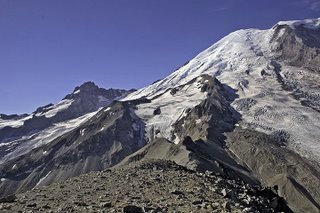
In the meantime, it's warm and dry on the mountain. Camp Muir enjoyed a balmy low of 49 last night! It's at 59 degrees as of 9 AM.

Image by Rob Veal

Tuesday, April 20, 2010

CT walking wounded ?

For those that might have missed it Dave Searle, our great new gear reviewer, broke his knee at Grand Montets skiing last week. Not like Dave to be crashing on piste :)


http://searler.com/


Here's hoping for a quick recovery,Dave! New reviews from Davemight be a bit slow in coming though after a full week in the hospital putting his knee back together!


On the other hand, today was the first day of exercise for me that wasn't just puking in months. So writing and climbing can't be far behind.


http://coldthistle.blogspot.com//10/what-one-learns-and-second-chances.html

Thursday, April 15, 2010

Northward Bound

Tuesday, April 19th - - After four lovely days of visiting friends in northeast Louisiana, I headed north on Sunday morning (April 17th). My goal was to get back to Indiana without traveling on Interstate Highways at all and to avoid four-lane highways as much as possible. That I have done thus far but I'm only halfway there!


I stopped at the Civil War Interpretive Center in Corinth yesterday (a post is forthcoming on that visit). Last night I stayed at this beautiful State Park in Mississippi – the Natchez Trace Parkway runs through it – and got on the Parkway this morning.


My campsite alongside the lake at Tishomingo State Park in northeast Mississippi.


The sun had been hidden by heavy clouds all day but showed itself for a few minutes late in the evening.


I just love the “green” all around. Delightful. And easy on the eyes.

Tuesday, April 13, 2010

Gunks Routes: Yellow Ridge (5.7)


(Photo: coming around to the stance beneath the off-width on the first pitch of Yellow Ridge.)


Often described as the best 5.7 in the Gunks, Yellow Ridge delivers a classic Fritz Weissner old-school sort of experience. An intimidating 5.7 off-width crack looms about 10 to 15 feet off the ground. The first belay traditionally follows directly above, and then the second pitch follows a path-of-least resistance 5.5 traverse up and left to a decent ledge. Then in the final pitch comes the glory: a thin traverse left to an arete and an improbable 5.6 haul through great jugs to the top.


The first decision confronting the climber is how to get to the off-width. Guidebooks have differed as to which approach is the original route; one can climb up to the off-width from the left, from the right, or directly up a nose from below. Dick Williams' latest guidebook suggests the approach from the right. This approach has the advantage of being the only start with good protection. When I led the pitch in March, this is the way I went, and I thought it was a bit strenuous for 5.7, but very secure and fun. The climb begins up a left-facing corner and then traverses under a low roof to the nose beneath the off-width. A good undercling crack provides great pro and hands for the traverse. The feet are quite smeary, however, and this part of the pitch really gets the pulse going, quite close to the ground. Then it's a fun maneuver rocking over the top of the nose to the stance beneath the off-width.


The off-width itself is kind of a letdown. I doubt even Fritz grunted up the thing. There are enough little edges around it that there is no need to use the wide crack to advance. I brought up a couple big cams just to see if they'd be useful, and it turned out they were totally unnecessary. I placed a gray #4 Camalot just above the piton at the base of the off-width. It wouldn't fit any higher. I suppose it had value in backing up the pin, but a #3 would have gone in almost as high. Then about half-way up the crack I placed the purple #5 Camalot, but right there a good horizontal also appears which takes a variety of different cam sizes. So leave the big gear in your bag, there's no point in bringing it for Yellow Ridge.


Traditionally there is a belay at the ledge above the off-width. I wasn't experiencing any drag, even though I placed gear both before and during the traverse beneath the roof at the start of the pitch, so I elected to continue through the easy 5.5 moves up and left to the final belay ledge. Here my partner Adrian took over for the 5.6 money pitch. I had been through this area before, but never from this direction. Instead I had previously done the final portion of Yellow Ridge by approaching it from the other side, through a link-up climb called Basking Ridge, which ascends the excellent 5.7 first pitch of Baskerville Terrace, then moves to the right and goes up a cool rising traverse around a corner to the right to join Yellow Ridge at the arete below the overhangs.


When I climbed Basking Ridge last year and came around the corner to join Yellow Ridge at the arete, I looked to the right and thought the Yellow Ridge traverse looked a little thin and intimidating. This year, Adrian made it look very easy, then moved up, clipping the pins that are the only pro for a while through the arete section. Then he started to move out of sight, but he paused beneath the overhangs. As I've mentioned before, Adrian is a recent transplant to the Gunks. He is used to climbing out in Squamish, where the cracks are vertical and the roofs don't tend to go at easy grades.


"Do you know where I'm supposed to go?" he asked. "There's nothing up there that looks like 5.6 to me."


"Straight up!" I said.


"Really?" I think I see a pin off to the left through this filthy gully..."


"NO! No! Straight up, man. You'll see, it's nothing but jugs and awesomeness."


"I trust you, but it doesn't look that way..."


"I've done it before, really, I'm quite sure about this."


"Okay, okay."


So Adrian headed upward, and after a short period of silence, he let out a great whoop, and yelled:


"5.6 in the Gunks!!"


And that's the magic, really, of a climb like Yellow Ridge, and of so much climbing in the Gunks. It looks like it's going to be absurdly hard, and it is actually quite steep, but the holds are so great it really is fair to call it a 5.6. Powering through these overhangs is a joy, a special kind of thrill you don't get anywhere else from such moderate climbing.


When I followed the final pitch I thought the traverse to the arete was nice but no big deal. A couple of delicate face moves and it was over. Having done the whole climb I had to conclude that Yellow Ridge is not the best 5.7 in the Gunks. Aside from a few nice moves at the bottom, the climb is just okay until the wonderful, outstanding final overhangs. I think that Basking Ridge, on the other hand, is a legitimate contender for the "Best 5.7" crown. Starting with the technical, challenging thin corner of Baskerville Terrace, it then offers an airy, rising traverse to the Yellow Ridge arete that is more exciting than traversing in from the other direction. You also arrive on the arete a little lower than you do when you come in from Yellow Ridge, which adds a bit more exposure as you move up to the pins and then the final overhangs.


And I have another idea for what might be the very best, and most direct, link-up that leads to the last pitch of Yellow Ridge. It would start with the classic first pitch of Fat Stick (5.8), which I've never done, and then climb the second pitch of Fat Stick Direct (5.10(b)), which I've also never done. This would place you just to the right of the belay for the final pitch of Yellow Ridge, which you would then do instead of the R-rated third pitch of Fat Stick Direct. This link-up would produce an awesome moderate climb with a well-protected 5.10 roof crux in the middle. If I get the guts to break into 5.10 this year, I'll definitely give it a try and report back!

Sunday, April 11, 2010

Moving On :: Kluane to Haines

Monday, August 23rd - - I continued on the Alaska Highway from Lake Kluane to Haines Junction where I turned south on the Haines Highway. Designated a National Scenic Byway, it is one of the prettiest drives in Alaska (in my opinion). What makes it different from all the other Scenic Byways is that you have scenic views that can actually be seen! They aren't completely hidden by rows of trees alongside the highway. The 150 miles from Haines Junction takes you through a portion of the Yukon Territory, British Columbia, and Alaska.

I didn't take many pictures along the way. Though pretty, the scenery didn't lend itself well to picture taking, and the further south I drove the cloudier it got. So you'll just have to take my word for it that it was beautiful.

There was some road construction and about 15 miles of gravel road, and my van, which had to go through two car washes in Anchorage to get clean, was now dirty again...

There were signs of autumn in the air, besides the chilly weather.


It had started raining about 30 miles north of the Alaska border and the rain continued all the way to Haines, 40 miles south of the border. I stayed at the campground at Chilkoot Lake State Recreation Area (which also happens to be where Sue and Fred stayed). It is ten miles east of Haines at the end of the highway.

Covering Distance


Last week I did two 100 mile rides several days apart. The first I rode on my own bike, with my camera, stopping along the way. That was really nice. The second I did on an unfamiliar demo bike, riding the course straight through except for a lunch stop. That was really nice too. The rides didn't take all day and they didn't wipe me out, allowing me to work before and after.Had time been no object, I felt as if I could have kept going.


To me, it is this private moment of realisation that "I have it in me" to do this kind of distance, casually - that feels like an accomplishment. More so than, say, an official brevet finish. It is not that I don't value organised events and their objective measures of performance. It's more that when doing an event, I already know that I can do it; I would not attempt it otherwise with all the logistics involved. In that sense, it feels not unlike taking a test based on material I've already learned. It's the learning itself that's thrilling. That "A-ha!" moment. Doing well on the test? It's nice, and often necessary. But it's not the same as the learning itself.


Maybe this line of thinking just means that I am hopelessly non-competitive. Or maybe it is simply not a good analogy. In fact almost certainly not. But there's a grain of something in it, somewhere.


Covering new distance, covering new material. And along the way that feeling of having truly grasped, understood, internalised something new - something that had previously seemed unattainable.

Thursday, April 8, 2010

Arches National Park


Great morning in Arches... headed out well before sunrise so I could be at a vantage point that allows you to see Turret Arch THROUGH North Window... it's an awesome view. Once the sun came up and the first light started to hit the arch, the rocks just GLOWED. It was awesome. I shared the spot with a medium-format film photographer from Montana.


I spent a couple of days at Arches, which is a park that I do not like during the day... there are just too many people. Early in the morning and late in the evening, however, it is sublime. Last night in the park was incredible. It was so quiet you could actually hear yourself think. The intense quiet of this evening is quite a stark contrast compared to a couple of days ago in the photography blind in Nebraska, with the sound of several hundred thousand Sandhill Cranes filling the air. Tomorrow I'm off to Page, Arizona to photograph Antelope Canyon!


Above: Sunset hiker at Turret Arch


Dead Trees

Here is a shot of two of the cottonwood trees that were killed by the fire but haven't been carved into figures yet. The sandhill crane on it's tree trunk can be seen in front. If you look close you can see Coors Blvd behind the park with the housing develpment that is to the west of Coors Blvd. The parking lot for the park can also be seen along with a distant view of the eagle.

Monday, April 5, 2010

Georgia Sunrise

Funny thing about how the world turns... for every sunset there is a sunrise. Though ordinary they might be, each one is a sight to behold. I don't often get up early enough to catch the sunrise but on this particular day I was camped along the northern shore of a little inlet on Lake Blackshear in Georgia Veterans State Park and I was awakened by the early morning light. The colors in the sky were magnificent. But, of course, by the time I had gotten around and outside some of the awesome color had dissipated somewhat, but it was still quite nice.


February 1, .. at 7:16 am Central Standard Time.


Taken at 7:29 am.


It never ceases to amaze me how quickly the light changes and the dramatic effects, especially during the times of a sunrise or sunset.


Friday, April 2, 2010

Route updates and more incidents

There are a number of climbing conditions updates now that the mountaineering rangers are regularly patrolling the standard routes. The Gibraltar Ledges, Emmons, DC, and Kautz were all climbed last week and we still welcome your reports if you're out and about...

This weekend went by without a mountaineering "accident," but their were "incidents." The first one involved three climbers who separated while descending from high camp on the Kautz Glacier. Two climbers (the faster pair) took off hoping to wait (relax) in the parking lot for their buddy. Can you guess what happened next? After spending much of the day wondering where their "teammate" was, the climbers finally contacted the NPS hoping to initiate a search. Sparing you the details, the third climber eventually showed up on his own many hours later. During which, his buddies were sent out to retrace their descent. Free advice: if you set out as a team, stick together. This is especially the case on descents that involve glacier crossings and cloudy/whiteout type weather.

And once again, we had another team use a cell phone to call their emergency contact and 911 for information and directions. Thankfully, the climbers worked out the issue before the NPS had to dispatch a climbing ranger team. Really, be prepared to sit out bad weather (which is common) on Mount Rainier, or become fodder for this blog. ;)

And speaking of cell phones, I've been getting a few questions about the "preferred" cell phone provider on the mountain. Truth is, I don't know. I think that each service does better in some places and elevations than others. That said, I'd be curious to get your comments on where your cell phone has worked and where it didn't (we know they work well on Liberty Ridge BTW). If you've used one while climbing (it can
be fun to call a friend while on the mountain) send me your comments so that they can be shared with other climbers.

The last and most significant mountain "related" news involves a search for a missing day-hiker on Eagle Peak. A 47 year old man didn't return from his hike last Saturday. I suspect that there will be more information released on this issue if things don't get resolved soon, stay tuned.

And if you're wondering, the opening photo is from the now famous Camp Schurman toilet seat. Dmitry Shapovalov's wanted to share the view with all of you. But if you head up there today, don't expect to see this unless you leave the NEW door open! Let's hope that this one makes it through the summer.

Thursday, April 1, 2010

Up Close


You can see the white truck and trailer which gives a good idea just how big hot air balloons are. Balloon crews use a pickup or SUV with a trailer to haul their balloon and gandola around. Once the balloon is up and away the truck tries to follow the balloon from the ground. Of couse they use cell phones and 2 way radios to help keep track of the balloon. Some balloon owners bring their own chase crew, as the people who follow the balloon are called but some don't and the Balloon Fiesta is always in need of people to work on the chase crews.

Doesn't Even Have a Top Tube


Notice Anything Different About This Betty?
Rivendell Betty Foy [review here]


The other day I received an email newsletter from Rivendell, where, among other things, they announced that their mixte model - the Betty Foy - is becoming their most popular bike... which, they promptly added, "wasquite a surprise considering it doesn’t even have a top tube."


Okay, so I know that was meant to be tongue in cheek. At least I think/hope. But it references a sentiment that is prevalent in the bicycle industry: that step-through/mixte frames are inherently inferior to diamond frames and therefore it is not worth making them with the same degree of care, precision and attention to detail. After all, customers are unlikely to buy these frames at the same price point as diamond frames.This idea comes from the fact that the "two triangles" design of the diamond frame construction is stiffer and stronger than any variation of the step-through design, and I do not intend to disagree. But there is more to a bike than that, particularly when we are talking about "real world" bikes. When it comes to accessibility, ease of transporting a rear load, and cycling in one's everyday clothing, step through designs are in fact superior. It is no surprise that people are willing to pay for them.


Soma Buena Vista Mixte 650B
Soma Buena Vista [review here]


When I considered buying a Betty Foy over two years ago, it left me with mixed feelings to read the following in the description of the bike: "This style - mixte, lady's bike, step-thru, whatever you like to call it - came about originally to allow a woman's dress to drape gently down so it wouldn't get blown up by the wind. Most women don't wear dresses anymore, and if they do they don't ride bikes in them; but there remain benefits to this style frame..." And this was the manufacturer talking, trying to sell this bike? Sheesh. Walk into any clothing store or office building, and it is clear that women can and do wear skirts and dresses. And why on earth should they not ride bikes in them?The Betty Foy's popularity is not news to me, or to anyone else who is familiar with the female bicycling blogosphere. Countless women with an online presence pine for this bike, if they don'thave one already. After all, bikes like the Betty and the Soma Buena Vistaare well-suited for hilly, long distance real-world North American commutes, and many women turn to them when Dutch-style bikes prove not to be sufficiently fast or light for their needs. But there aren't enough bikes like this made; we need more.


I was so excited when Velo Orange introduced its lugged mixte in , and I was equally disappointed when they discontinued it in - due, apparently, to less than stellar sales. I have a theory about why the VO mixte did not sell, and I will state it at the risk of being perceived as sexist. My impression is that (despite some vocal commentators ready to argue the opposite) it is women who mostly want mixtes. But VO was reluctant to cater mainly to women, and so they intentionally made the colour scheme aggressively sporty/ masculine just to say "look, this bike really is unisex!" Okay, yes technically it's unisex. But what ended up happening, is that many of the women who would have otherwise loved to buy a lugged mixte frame found the colour scheme unappealing. And the men did not want a mixte in the first place. I have a strong feeling that if VO were to introduce the same frame in a different colour it would sell. I hope very much that they give this a try some day.


Royal H. Mixte, Garden
Royal H Custom Mixte [review here]


Even custom framebuilders have a difficult time constructing lugged step-through and mixte frames, because standard lugs for these designs are no longer available. A few years back Reynolds stopped producing tubing suitable for mixte stays, which is why Mercian has discontinued their classic mixte and now makes only this. I believe there is money to be made in producing batches of split-stay mixte lugs and tubing, for anyone interested.


Bike manufacturers need not be afraid of step-through frames. And they need not be afraid of catering to women. And they need not be afraid of acknowledging the fact that many women wear skirts and dresses, and for this and other reasons they prefer step-through frames. Please do make bikes without top tubes, and make them nice. Rivendell is a case in point that it makes sense financially.