Sunday, March 27, 2011

The Big Sandbox

After nearly two beautiful weeks at Zion National Park, the weather took a turn for the worse the morning I left. I had checked the weather forecast for Bryce Canyon. It didn't look good. High probability of snow the next few days. Looking at the map I saw that the Coral Pink Sand Dunes State Park was on US 89 a few miles southeast of Zion. (US 89 North is the route to Bryce Canyon.)

I had some extra time since I had left Zion rather early so decided to take an indirect route which took me through the mountains to Hurricane and Apple Valley in Utah as well as Colorado City and Moccasin in Arizona. It snowed. And rained. And snowed some more. The higher elevations had several inches of the white stuff on the ground. Back in Utah, I stopped in Kanab at one of the smallest McDonald's restaurants that I have ever seen! But they had free Wifi. At one point it was almost a white-out with big flakes of snow blown by the swirling wind. But that didn't last very long. By the time I left, about an hour later, it was still cold but it had stopped snowing and the sun was shining!

Coral Pink Sand Dunes State Park is a few miles north of Kanab. I checked into the campground and found a site. Then, after adding another layer of outerwear, went off to play in the sand dunes. Did I mention that it was cold and windy? But the sun was shining. Well, sometimes it was – when it wasn't hidden by clouds. Still, it was a wonderful day.

The two largest dunes, in the distance, are about 100 feet high. And yeah, I climbed to the top of both of them. To me, they didn't seem to have that “coral pink” color although the color did change depending upon the intensity of the sun and shadows from the clouds.


above: The southern big dune as seen from the top of the other one.


Friday, March 25, 2011

Climbing Moby Grape (5.8), Cannon Cliff, NH


(Photo: a portion of Cannon Cliff, with some wetness clearly visible.)

A few weeks ago I got to bring to life a little dream of mine. I've been wanting for a couple years to do a long route on what passes for a big wall here in the Northeast, either the Diagonal route (5.8) on Wallface Mountain in the Adirondacks, or the Whitney-Gilman Ridge (5.7) or Moby Grape (5.8) on Cannon Cliff in New Hampshire. Until recently this dream has remained unrealized because I didn't want to take a whole weekend away from my family in order to do the climbs, and I didn't have a partner for whom it seemed to be a priority.

But then this summer I met A, who recently moved to NYC from Vancouver. He's been climbing at Squamish for two decades. Big walls are his bread and butter. It wasn't long into our first climbing conversation that I confessed to him my burning desire to go North to hit one of these big faces.

Then when A and I started talking about heading up to the Gunks for a weekend day a few weeks ago, A asked me if I wanted to head up to Cannon Cliff instead. It was like I'd rubbed a lamp and a genie had suddenly emerged. There was no way I was saying no. The only problem was that I couldn't take both Saturday and Sunday to climb. I quickly hatched a viable, if kind of brutal, alternative plan: we would head out Friday night and drive 5 or 6 hours to the vicinity, crash in a hotel, get up early, hit Moby Grape (and maybe the Whitney-Gilman too if we were really moving fast!), and then drive the 5 to 6 hours back home Saturday night. This way we'd be done in a day. A marathon day, but just a day nonetheless.

For some reason A agreed.

We drove out on Friday night, heading up Route 91 through Vermont until the junction with Route 93, which goes down through New Hampshire to Franconia Notch State Park, the home of Cannon Cliff. I had printed from Google a list of nearby hotels but I didn't think we would need it. I assumed there'd be room at the local Comfort Inn since it wasn't yet leaf season.

Unfortunately I was mistaken.

We pulled into the Comfort Inn lot at about 12:45 a.m. When we went inside, a very smug young woman seemed thrilled to tell us that they didn't have a single room for us. I asked her if she knew of any other hotels in the area with rooms and she replied with certainty that no one else would take us either. I never found out why the hotels were allegedly so packed. I couldn't wait to get away from this unpleasant person, so I neglected to ask her.

Back in the parking lot we were debating whether to drive around looking for another hotel or to simply try to sleep in my Subaru when I remembered my printed-out list of hotels. Several surreal phone calls then ensued, in which I called numerous different hotels only to reach the same late-night hotel desk man over and over again. It turned out that in the St. Johnsbury, VT area (where Route 91 meets Route 93), most of the hotels have no one at the desk at night, and a few different hotels have their late-night incoming calls routed to this one person who mans the phone for the Fairbanks Inn. I had a few conversations in a row with this same gentleman, and in each case he was equally incapable of determining whether any rooms were available at whatever hotel was in question. (He actually left me a message later offering me a room after we'd made other arrangements.) Finally we lucked out when I awoke the proprietress of an amazing little slice of history called Injun Joe Court. I'm not kidding. This place really exists. The lady told us to come on over, and she waited up for us, so I decided against asking her about the name of her establishment. We finally got to sleep about 1:30, vowing to get up at 6:00 so we could find breakfast and still get to Cannon pretty early.


(Photo: the sign for Injun Joe's. Crazy, right?)

We got up pretty much on time and had an indifferent breakfast at the Joe's Pond Country Store nearby, making it to the Cannon Cliff parking lot by 8:00 a.m. Upon our arrival, we learned some potentially upsetting news from other climbers who were sporting a pair of binoculars. They'd been scanning the cliff, and they'd found that there were multiple parties already on both the Whitney-Gilman Ridge and Moby Grape. Also, the cliff was looking pretty wet. I wasn't really surprised to find other climbers at Cannon on the weekend, but I didn't think it would be so crowded so early. It was supposed to be a nice day, in the sixties, but the whole park was still shrouded in fog. And as for the wetness, that really did catch me by surprise. It had rained pretty heavily two days before down in the NYC area (this was the time of the Brooklyn "tornado"), but after a full dry day I didn't expect it to be so wet on the rock.

What could we do but make the best of it? We'd come all this way. We weren't turning around. We geared up and hiked through the big talus field to the base of Moby Grape, and it immediately became apparent that we would not be doing more than one route on the cliff. We were already the fourth party of the day on Moby Grape. And the second party was not yet finished with the first pitch.

When we finally got started, the route turned out to be excellent, even though it got wetter and wetter as we progressed towards the top. Many climbers know of the famous features on the route, such as the triangle roof on the third pitch, and the Finger of Fate on the fifth. But the route has so much more than that to offer. Nearly every pitch has at least one unique feature offering a specific challenge to the climber. And despite what you may have read, nearly the whole route features good climbing on solid granite.

Generally good rock notwithstanding, as an alpine route on an exfoliating cliff Moby Grape certainly requires more commitment than your average Gunks 5.8. And with numerous sections featuring vertical jam cracks and granite slabs, the climbing was largely alien to a Gunks climber like me. Once the wetness variable was added to the equation I was thrilled to have an experienced granite climber like A along. I knew he'd be happy to lead all the crux pitches and in the end he led some of the ones designated for me as well.

We had with us the Jon Sykes guidebook to the area, Secrets of the Notch. Since there was a conga line of climbers ahead of us on the route, we barely used the book. Looking at the description in retrospect, it seems adequate to me, but no more than that. The description on mountainproject.com is really quite poor, leaving out a lot of crucial directions and inaccurately dismissing the climbing that follows the "finger of fate" to the top of the cliff. Probably the best route description can be found on the website for Chauvin Guides.

Pitch 1 (5.8)


(Photo: climbing Reppy's Crack, close on the heels of another party.)

We started, as I imagine most people do these days, with the Reppy's Crack variation. This pitch features a perfect hand jam-crack for about 120 feet, which is then followed by fun moves around a corner and up to a bolted anchor. I actually considered leading this pitch, despite my complete lack of experience with jamming. I figured I knew intellectually what to do, and that by the end of the pitch I'd get used to it and have it down. But jam cracks are A's specialty, so I deferred to his desire to lead the pitch, and I am so happy I did. After A flew up the thing, obviously enjoying himself and declaring the crack to be the equal of anything in Squamish, I slowly suffered to the top. I found the hand jams awkward, the foot jams painful. My progress was too slow, increasing the pain. And it never let up. No particular move was too hard, but the whole experience was just exhausting for me. Before the crux pod I felt one of my hands start to slip and I just let the fall happen. I needed a rest. Then I did the crux step up out of the pod without any trouble, and just willed my way to the end of the pitch, constantly wishing it could be over. I arrived at the belay a little demoralized. I vowed to get some practice jamming, but without a multi-day trip to Yosemite or Squamish I'm not sure how I'm going to get enough practice to improve! The rest of the climb went much more smoothly for me, without a moment's fear that I would actually fall, and the ratings on the whole seemed fair.

Pitch 2 (4th Class)

This is the route's lone throwaway pitch. It is about 90 feet of easy scrambling, starting left up some blocks and then up a corner to a good ledge at the base of steeper rock.

Pitch 3 (5.8)


(Photo: climbing up to the triangle roof, again not far behind another group.)

This is the physical crux pitch, featuring the triangular roof. The roof is a fun 5.8 challenge, one that any Gunks climber should have no trouble with. Something the guidebooks don't tell you is that the moves to get to the stance below the roof, up a right-leaning seam with slabby feet, are also tricky, and contribute to the sustained fun of the pitch. After pulling the roof it is another friction step up to a good ledge, which can be followed to the right for a belay at some suspect blocks.

Pitch 4 (5.7 or 5.8)


(Photo: working up the pitch 4 corner.)

This was one of my leads, and perhaps because A told me it was a 5.6 I thought it was easy. I later learned that Sykes calls it a 5.7 in his book and the Chauvin Guides' site describes it as 5.8. I thought this pitch was different from all the others and lots of fun, with somewhat committing moves up a layback crack for about 15-20 feet up to the right and around a corner, then up easier rock slightly to the left to a ledge, pretty much directly below the shark's fin-shaped feature known as the Finger of Fate. While A thought the layback was insecure, it didn't worry me much because there are good (if small) edges for feet wherever you need them.

Pitch 5 (5.8)


(Photo: getting into the Finger of Fate.)

The challenges of this pitch are more mental than physical. The Finger of Fate is actually the second challenge of the pitch. The first is a feature known as the Sickle. This curved, crescent-shaped rock starts almost horizontal and then curves up sharply to the right. There is a fun slabby step with crimpy fingers over to the Sickle, then a hand traverse to the right until your hands are high enough for you to pull your feet up so that you are standing on top of it. In my opinion this is the best part of the pitch. While the Finger of Fate looks intimidating from below, it is actually very easy to climb. People tunnel behind it from either side; when A got to it he chose the right. I made things more difficult for myself while following by stubbornly trying to climb it with my pack on. I had seen an earlier party climb it with packs, but theirs were much smaller than mine. I couldn't fit through with mine on, and I found myself basically stuck while straddling the Finger, unable to fit my body through so I could sit on top of it. I ended up slowly taking a sling from around my shoulder, attaching the pack to my harness with the sling, and then struggling free of the pack, all the while balancing my torso atop the Finger and staring straight down about 400 feet to the bottom of the cliff. I'm sure it made quite a sight; I wish I had pictures! Once atop the finger, this great pitch isn't quite over. There's still a low-angled slab move or two to some good holds and then a big grass ledge. These slab moves are not hard, but they are impossible to protect well and a fall here on lead would send you tumbling past the Finger. When we did it, the slab was wet, and I didn't envy A having to lead the pitch. It was a sign of what was to come for the rest of the climb.

Pitch 6 (5.7 or 5.8)

This pitch begins with a couple bouldery moves up a little polished channel. When we got there, we found out why it is polished: it was running with water, soaking wet. A kept telling me that my toes would still stick on wet granite, and it turned out he was right. The pitch isn't bad, even soaking wet. Past the start the climbing eases past some more slab moves on lower-angled granite to a belay below a chimney.

Pitch 7 (5.7)

When you look up at the awkward move out of the chimney and around onto the face of the cliff, it is hard to believe it is rated 5.7. It turns out to be just as awkward as it appears, and the committing move out from the chimney, if blown, might lead to a pretty nasty swing backwards. Nevertheless I think this pitch is really fun and different from all the others, and it is totally unheralded. There is a great handhold to latch onto before you make the move, and the challenge of the pitch is figuring out how to squirm your body around to grab the hold effectively. Once you've got it (and I'm not telling you which hand to use!), it's just a couple moves up and around onto the face of the wall, then easier climbing straight up to a good stance.

Pitch 8 (5.6)

There is a popular alternate finish to Moby Grape, a 5.7+ left-facing dihedral called Curt's Corner. We'd hoped to try it out, but it was really wet, just running with water. The guidebook described another 5.6 finish to the right, but looking up neither of us had much of a clue where we were expected to go. I tried to find the line, but failed, and then A came up and picked out a line I wasn't even considering, getting us off the route in no time. I have no idea whether we found the correct finish.


(Photo: a view from the top.)

The descent from the top of Cannon reminds you how far you've come up. It took us more than an hour to get down, but this may have been partly because the descent path was damp and slippery. For us it was borderline unpleasant, but I bet in drier conditions it would be no problem at all.

As we left and I steeled myself for the 6 hour drive back to NYC, I tried to look on the bright side: this would make the commute to the Gunks seem short!

Tuesday, March 22, 2011

Wow! I've been nominated...

Thank you so much to everyone who nominated Kinexxions for the Family Tree Magazine 40 Best Genealogy Blogs (in the Personal/Family Category)! And congratulations go out to all of the other nominees.

The editorial staff of Family Tree Magazine will be selecting 40 blogs in the various categories for an article scheduled to be published in the May .. issue. Blogs were nominated by readers last month and the voting is now open (and will continue to November 5th) to determine the final 80 blogs that will make the cut.

Blogs were grouped into 10 different categories based on the purpose or intent of the blog: All-around, Personal/Family, Local/Regional, Cemetery, Photos/Heirlooms, Heritage, News/Resources, How-to, Genealogy Companies, and Genetic Genealogy. The Genealogy Insider has more information about the categories.


Caution, shameless plug coming. . . I realize that Kinexxions has been a bit preoccupied with some traveling and hasn't posted much content recently that is related to family history but if you'd care to vote for me I'm near the bottom of the list (hopefully that doesn't really mean anything ;-) in the Personal/Family category. And, hey, you can even vote more than once if you'd like to!

Update October 6th:
I've been informed by Bill West (thanks Bill!) that the list of blogs in each category changes each time you view the poll, so you'll just have to look for the blogs for which you want to vote. Also, the illustrious footnoteMaven (who has been nominated in two categories!) has created a list of links to each of the nominated blogs, which is quite helpful in reviewing the nominees prior to voting.

Sunday, March 20, 2011

Gunks Obscure Tour: Rock & Brew (Pitch 3, 5.8 R) & Uncle Rudy (Pitch 3, 5.7+)


(Photo: Just getting started on the 5.7 pitch 2 of Morning After.)


Another warm winter day. Nice to be climbing without a jacket, wearing just a couple of base layers on February 1, but I couldn't escape the global warming angst. It felt strange.


What a beautiful day! (We're all going to die.)


Actually, the day began with rain. It was coming down in a steady drizzle as we left the city, but we had faith in the forecast and by the time we arrived in New Paltz the rain was done. We warmed up on the Pebbles Boulder while we waited for everything to dry out. Then we headed for the Drunkard's area.


I had the idea that we could check out a few upper pitches on the Drunkard's Delight/Morning After wall. I'd done the first two pitches of both of these great 5.8- climbs. It seems that's all most people do. Most folks just rap from the GT Ledge and don't do any of the third pitches in the area. I had bucked the trend once before, climbing the 5.5 third pitch of Bloody Mary. I concluded few people must bother with it; it is dirty and uninteresting. I had to dig the dirt out of some cracks in order to place pro.


But despite this experience on Bloody Mary (the first two pitches are awesome, by the way), I had a feeling people were missing out on some good climbing above the GT Ledge on this wall. I'd read good things about the 5.8- final pitch of Morning After and I thought it would be fun to check it out. It was reputed to feature an unusual crux layback rail.


I was also intrigued by the third pitch of a nearby climb called Uncle Rudy (5.7+). The pitch receives no stars from Dick Williams, but he calls it "really nice."


(Photo: Oops, that's not Morning After! The 5.8 R third pitch of Rock and Brew.)


The first two pitches of Morning After went well. (I always especially enjoy the 5.7 face climbing on Pitch 2.) Once we reached the GT Ledge I was certain I spotted the correct third pitch. I hadn't consulted the guidebook, but I saw a right-facing flake system which I figured had to be the layback rail I'd heard about. And the rock was clean. It looked fun.


Adrian asked about a dirty corner system just to the left but I was firm in my (incorrect) beliefs.


He started up bulgy white rock. The climbing didn't look bad but he had to fight with a pine tree to make progress. He was actually grateful for the tree, however, since it was the only source of pro. he slung the tree twice.


Nice moves took him past the right-facing flakes. This part of the pitch actually had decent placements, and the climbing seemed reasonable.


Then Adrian arrived at the real problem. He reached another pine tree to find a blank slab above with with no pro leading to the top. A rap tree (which I believe is the Rusty Trifle tree) was off to the right, but traversing over was also lacking in protection opportunities. Adrian eventually chose to traverse to the rap tree rather than heading upward. He risked a pendulum if he fell, but he made it over to the tree and then brought me up.


By the time I reached the flakes I realized I'd steered Adrian wrong. The flake moves were fun, but they were very easy and unworthy of being described as an interesting layback sequence. Later I read the descriptions in Dick's book and realized my error: we had done the third pitch of Rock and Brew, which Dick rates as 5.8 R. Seems about right.


Of course, Adrian's choice to traverse to the Rusty Trifle tree left me with the same pendulum risk as a second. It served me right, but I didn't enjoy it. Putting my hands on the blank slab, I gingerly placed my feet on ledges covered in tufts of dirt and pine needles. I felt with each step that I might plunge through and go for a ride. But I made it over without incident and with some relief we rapped back to the GT Ledge.


If I'd been leading I probably would have put my cordalette around the top pine on Rock & Brew and bailed without risking the blank slab or the traverse.


In the final analysis, I'd say the pitch has a little decent climbing on it, but I don't recommend it.


Once we were back on the GT Ledge I got set to lead the third pitch of Uncle Rudy. This 5.7+ climb doesn't get done much because the first pitch is dirty and the second pitch is runout. But there seemed to be nothing wrong with pitch three and this time I knew I was in the right place. The start of the pitch is hard to miss, beneath a large right-facing corner system at the right edge of the Drunkard's wall. (It has the same start location as pitch two of Bloody Bush (5.6).)


This time our adventuresome spirits were rewarded. The final pitch of Uncle Rudy is great. I think it deserves at least one star. Maybe even two stars.


It has two nice cruxes, each one different from the other. The first comes as you climb up into the corner to a roof and then make a very airy (but juggy) exit out left. Then you head up and a little right to the second crux, a nice 5.7+ ceiling.


Clean rock, great exposure, interesting climbing, and an exciting finish. What more could you ask for? I think this is one of the better 5.7 pitches in the Gunks. And 5.7 is a grade that needs better representation at the Gunks.


I think this pitch will be high on my list to repeat whenever I end up on the GT Ledge in this part of the cliff.


(Photo: Past the low crux on Drunkard's Delight (5.8-).)


After we got down to the ground I finally led Drunkard's Delight for the first time. As I detailed in my prior post, I had bailed on the lead once before, in the immediate aftermath of my broken ankle, and followed it on a later date. After following Drunkard's I had decided it was a reasonable lead, but I just hadn't gotten around to it.


This time with Adrian I linked both of the first two pitches in one and had a blast. (I wouldn't recommend this if you feel your second is at all likely to fall on the opening moves.)


Then we ended the day on pitch three of Maria (5.6+ and another great third pitch option in this area). As I belayed Adrian it occurred to me that, given it was only February 1, I was feeling pretty good on the rock! The climbing felt reasonable and I wasn't too rusty with the gear. The day gave me hope that I could start the season strong and get on some ambitious climbs early in the year.

Why a double boot?


With reviews of the most popular double boots on the blogand more coming of similar models I think the use of double
boots might need some explanation again.


The majority of my alpine climbing has
been done in the Canadian Rockies in winter or in the Alaska Range in
spring.


In both places a good single boot and decent gaiter will get you
by, generally, in perfect conditions. The problems arise not in the perfect
conditions but in the exceptions both in the weather conditions and
temperatures. As important or maybe more import is the physical condition of the
climber.


Open bivy high on the North side of
Deborah May '76


Frostbite is not generally a cold issue
believe it or not but simply a physical exhaustion and dehydration issue of
climbers strung out in difficult conditions. Double boots are a reasonable
insurance policy to avoid a cold injury when you are dehydrated and exhausted
and still having to keep moving. Sounds pretty much like any worthwhile alpine
climb doesn't it?


While expensive, quality double boots are nothing
compared to the price of what even a short stint in the hospital from frostbite
and the resulting down time will cost you long term. Not to mention the
resulting cold sensitivity that will follow you well into the future. The result
of a serious case of frostbite is you'll either stop climbing in cold weather or
you'll buy double boots after the first incident. My suggestion is buy the
double boots up-front and save yourself the worry and pain.


With all the
new climbers able to get out and crag climb long before they jump on difficult
alpine climbs single boots are the norm. The single boots generally climb better
and are cheaper. The same single boots are generally over kill for most things,
including Rainier in summer. So, of course we all want to use those same single
boots...that aren't cheap either....all winter and on every climb.


A good
percentage of the time you'll get away with it. In Canada these days most
climbers won't go out if the temps drop below -15C. That is up from the old norm
of -30C as the temps we generally called it off. One of the reasons is most
boots are not comfortable climbing below -15C unless they are double
boots.


Galiber Makalu dbl boots, late
'70s.


The other important reason to
invest in double boots is the amount of time you can comfortably spend out in a
cold, harsh environment. No they aren't fun to walk in or climb difficult mixed
terrain in. But both can be done adroitly with a little practice. You might find
they climb ice better than your single boots in fact. On moderate, long, ice
routes, most will appreciate the added support and calf relief of a good double
boot. The most important reason to look at a double boot is the ability to keep
the liners unthawed and warm over night and if required dry the inner out in
your sleeping bag. If things really go to shit and you have an open bivy the
fastest way to thrash your feet is to be laced into a tight pair of single
boots. Better yet on a open bivy you can loosen a dbl boot a bit, gain some
warmth usually by doing so, and still keep your 'pons bolted on the boot and not
worry about loosing gear. It is a big advantage if actually required. Getting your steel crampons off your boots or better yet your boots off your feet is alwasy a better and warmer over all option.


The advantages of a
double boot are significant to keeping your toes and feet in good health. The
down side is first the expense, and then the ability to climb difficult ground
in them. That can be over come with time, by climbing more in your dblboots. Lastly the bulk
and weight. The newest boots are getting better. The Scarpa 6000 and La Sportiva Spantik are bothwarm, light and climb well.Worth the added effort to climb in doubles unless you feel like the risk of
damaged feet is lower than I do.


On frozen feet after an open bivy at
13,800 in Nov.


Some will wonder about the Batura and Phantom
Guide style of boots (single boots with attached "supergators") as a less expensive
(if $500+ is less expensive) option to a true double boot. This style of boot
has two design features that limit their use in similar conditions. They are
both very difficult to dry out and keep unthawed on over night or longer trips.
And the ankles are generally a lot softer and more flexible than a true double
boot. So you lose the extra ankle and calf support as well. My take having used
a Batura for a few years is they are good one day boots on cold days but I would
never take them out over night intentionally. Each style of boot has a place.
Just don't trust the advertising to help you decide when and what is right for
you.


Times haven't changed much. Good (read winter technical boot) double
boots would/do cost a lot more than a good (read winter technical boot) pair of
single boots. That changed for 20 plus years as plastic double boots dominated
the market place. No matter your skill or experience level plastic double boots
were common on almost every mountaineer's feet. And for good reason..they would
keep your feet warm and dry in just about any condition...some times too warm.
For years you could easily assume that anyone who did technical ice climbing or
went out in winter would own a pair of plastic double boots.


Not so today.
And because of it I am seeing and hearing of frost bite injuries again outside
of the greater ranges....which had been, until just very recently, a thing of
the past.

One of my litmus tests for winter climbing partners, 30 years ago
and again now is, "do they own double boots?" It doesn't mean that you use
double boots on every winter climb.

But if they do, I can generally count on
the fact they take their own survival and climbing seriously. That is usually
because of hard won experience in really cold weather conditions. So I can worry
less about them getting a cold injury and both of us staying healthy on our
adventures. And just as often the owner of a pair of double boots is likely to
value his partner more than some one with less experience would. Surprised? You
shouldn't be. It is all in the details.


If you plan to go BIG and go
LIGHT....the place not to short yourself on gear is your boots...go BIG there
first!


More on the end result of "minor" frostbite.


http://www.summitpost.org/frostbite/856321


A pair of Herman Buhl's cold
weather boots.


By comparison a light weight double boot for their time. Something the first Kolflachs were. And the recent TLT5 hinted at prior to the full blown ski boot with the introduction of TLT6.


The climbing world still waits for the super light technical double boot to catch up with themodern technology available.


Hermann Buhl (September 21,
1924 – June 27, 1957) is considered one of the best post-World War II Austrian
climbers and one of the best climbers of all time. He was particularly
innovative in applying alpine style to Himalayan climbing. His accomplishments
include:


1953 First ascent of Nanga Parbat, 8,126 metres (26,660 ft)
(solo and without bottled oxygen).

1957 First ascent of Broad Peak, 8,051
metres (26,414 ft).

Before his successful Nanga Parbat expedition, 31 people
had died trying to make the first ascent.


Buhl is the only mountaineer to
have made the first ascent of an eight-thousander solo. Just a few weeks after
the successful first ascent of Broad Peak (with Fritz Wintersteller and Marcus
Schmuck), Buhl and Kurt Diemberger made an attempt on nearby, unclimbed
Chogolisa peak (7654 m) in alpine style. Buhl died when he fell through a
cornice on the southeast ridge near the summit of Chogolisa. His body was never
found.


"Buhl was very lucky on Nanga Parbat, escaping with just a
few frostbitten toes. This story reflects Buhl's style of climbing; totally
focused and by taking enormous risks he often succeeded where others
failed."


Buhl on Nanga Parbat 1953


http://www.summitpost.org/article/173032/Hermann-Buhl-1924-1957-.html

Friday, March 18, 2011

Mt. Adams, North Ridge


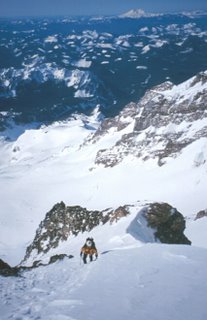
The Northwest side of Adams as seen from our high camp. The North Ridge is the one on the left edge of this photo. Our camp for this climb was at 6,900' and had running water!


Emily, Tania and Mark heading up the lower snowfields towards the ridge.


A small lake at 7,500'.


The upper part of the North Ridge.


Tania crossing over the ridge.


Taking a break, having a snack and staying hydrated.


Jason climbing a unique lava formation near 10,000'.


Ascending some scree high on the ridge.


We all made it to the top under clear skies. Doug, Mark, Tania, Emily and Jason. Congratulations to the 3 newcomers.


Tania descending beside the lava formation.


A couple of mountain goats at home on the colorful slopes.It was nice to finally climb a different route on this mountain. The terrain, greenery and wildlife made it seem like it was a different mountain altogether.

Gibraltar Ledges and Ingraham Glacier Direct Route Conditions

Two teams attempted these routes this week.

Tuesday at Camp Muir, two climbers departed in the morning hoping to climb the Ingraham Direct. The pair made it to 13K before turning around. They reported knee deep snow the entire way up the Ingraham Glacier. They also reported several crevasse crossings, most of which went smoothly. They stated that the bridges were in good shape and most were easy to cross. That said, one of the pair did take a crevasse fall at 13K... After a day of kicking steps in deep snow, the pair decided to descend after the crevasse fall.

Gibraltar Ledges was attempted on Wednesday by a soloist (carrying skis). He reported knee deep snow on the Cowlitz Glacier up to the beginning of the ledges. The snow on the Cowlitz was described as powdery, underneath a crust of varying thickness, but "thin" overall.


On the ledges, the climber experienced a lot of soft, sugary snow... Sometimes even waist deep. It took over 2.5 hours to traverse and climb the ledges. After pushing through what you get when you "open a bag of cane sugar," upward progress seemed futile. He turned around at 12,500 feet (about 3/4 of the way up the chute). It took over an hour to descend the ledges, as the footing was still quite challenging.

There is a boot path up the Muir Snowfield. The weather is supposed to be excellent this weekend.


Photo by Mike Gauthier, climber ascending Gib Ledges before the traverse and chute.

Monday, March 14, 2011

Mtn Hardware Minus One Glove

This is a retread from last month that got buried so Ithoughtit worth an update after I got more climbing use out of the glove.


I like a couple of glove manufacturers products. But I have to say I have been really impressed with the most recent OutDry products from Mtn Hardware. (and now the same technology is in the Scarpa boots) The newest glove I have been using is the Minus One..which is a thin, technical glove intended for leashless climbing and dry tooling in moderate temps.


It is a perfect fit for those uses.


It is not climbing but the temps dropped here to -10C over night and I had a bunch of outdoor household chores to take care of as we got several inches at snow and the temps continued to drop. This glove was good enough to use hand tools with and get everything done outside before our pipes could freeze up.


Last weekend I used the same glove on water ice with a good bit of free running water. I intentionally stuck my hands in the fire hydrant size spout of ice water on one climb to see just how water proof the OutDry system was. ( I had dry gloves in my pack and it was an easy day out) These guysreally are water proof. Although depending on the glove it may take some time to actually dry the leather out on the exposed side of the glove. I have since water proofed the leather as well on my Minus Ones. You'll still stay warm and dry either way. But no question the wet leather would freeze if it was cold enough.


Newest ones don't have a palm reinforcement that is pictures in the stock photo below but the thinner palm is awesome on a tight Nomic or Ergohandle. I wouldn't want to do a lot of rappelling in them though as it would get expensive quickly I suspect.


I've since used the Minus one in -20C temps on dry ice and a couple of rappels over a weekend and been satisfied. Then out with them again as my only glove (forgot my spares and approach gloves)in temps from 0C to -15C with everything from running water to a full onwet snow storm while wallowing in crotch deep trail breaking. The kind of day every thing gets wet.


Ten full days of climbing, rapping and belaying on these. I am impressed so far.

Best to save these guys for climbing. Knee deep wallowing will get anything wet, the Minus One being no exception.They will handle your sweaty hands and generally stay dry inside but they can be easily over loaded if you allow snow in from the outside. But they did dry over night internally. Theleather palm soaks up water pretty quickly even after being treated but itgenerally dried fully over night. I have 10 days of climbing on this pare and am happy they are holding up much better than expected so far. They have kept my hands warm even on the chilly days -10C.Much warmer that expected for their weight.


Down side besides price? The rubber strap and velcro closure at the wrist. I find it annoying as it could have been done in nylon just as easy and get in the way less. But minor flaw and I suspect Mtn H was trying to give some added wrist support by using the rubber strap.


Buy them on sale for around $80 is the best I have seen or retail at $100. Great glove for the intended use. I am impressed as a light weight, highly technical, cold weather leashless glove and it is a lot warmer than expected.


New Painting


I got this painting at a yard sale. The photo isn't that good. I love the colors. Artest has the last name of Hilton but couldn't make out the first initial - either G or maybe a Y.

Phend-Fisher Family Reunion Ledger (1922)

[page 1]
The thirteenth Annual reunion of the Phend and Fisher families was held at the home of Henry Phend at Columbia City Ind., on the first Sunday in September 1922.

There were 40 members and 7 friends present. The forenoon was spent in a social way. Songs were sung and games were played.

Blessing was offered by Jacob Phend after which a basket dinner was served. After dinner a short business session was held, Will Phend acting as president in Henry Phend's place. The secretary's report was read and approved and the following officers were elected for the following year.
Will Phend - President.
Ralph Ernest - V. President
Christ Phend - Treasurer
Fred Ernest - Secretary.

After the election of officers several short talks were given in which special emphasis was laid upon

[page 2]
the true Christain [sic] spirit which has always predominated in the Phend - Fisher reunions. Younger members of the reunion were urged to take a special interest and help to perpetuate the feeling of good - will and fellowship.

It was decided by vote that the next annual reunion would be held at the home of Jacob Phend, north-west of Elkhart on the first Sunday in September 1923.

Ice cream was served after the business session. Every body reported a good time and expressed their intention to be present at the next annual reunion.

Fred ErnestSec'y.


The Phend-Fisher families gathered for a reunion in Elkhart County, Indiana almost annually from 1909 until 1943. Usually held at Nappanee, the events of the day were recorded in an old ledger book. Spelling has been retained as it was in the original though some punctuation and paragraph breaks have been added. To view all articles in this series click on the "Phend-Fisher Reunion Ledger" label at the bottom of this post.

Friday, March 11, 2011

Honeyman State Park


A short walk from the campground and through the forest leads to this beautiful little lake surrounded by the forest and sand dunes. Double-click on the image to see a larger version... it is a portion of a panoramic view that doesn't quite capture the full beauty and serenity of the place, but does a pretty good job of it!


I sat up on top of this sand dune for several hours, listening to the quiet. The only other people around were those two youngsters at the edge of the water, far below. Optical illusion? After looking at this image for awhile, it is hard to tell whether you are looking down toward water, or up toward sky, either way, it was a long way up/down.


As the sun lowered toward the horizon I left my gorgeous viewpoint and ventured down to the small lake.


Jessie M. Honeyman Memorial State ParkSouth of Florence, OregonSeptember 29, ..

Santa Hat

Sonny agreed to pose in the Santa Hat as did all the other horses and ponies and even our cat Murphy who can be see at the end of this blog'

Boys & Pony


Preston and Jayson were thrilled to be able to learn about my pony, Stormy. They learned to groom him and lead him, but most importantly learned to be calm and gentle when around a pony. Stormy seemed to like all the attention. I was so proud of him. He had never been around young children and was so good with the boys. Of course I was right there with them at all times.