Sunday, December 30, 2012

Zephyr squash


Our first Zephyr squash. Should be ready to eat tonight!

I may have mentioned before that it's an experimentation year for squash. I planted eight different varieties, plus had one come up volunteer in the compost pile.

That volunteer squash turned out to be an acorn squash, sort of. It's either a not-true-from-seed hybrid or it's from the seed of a cross-pollinated one, because it was white-fleshed and not tasty at all. It was a pseudo-vegetable.

I have high hopes for my Zephyrs though. I'll let you know how it goes!

(As you can probably see in the picture, the grass in the garden really took off with the recent rain.)

Wednesday, December 26, 2012

No, it's REALLY raining up here

The southside of the park is closed; the rain has started to wash out or significantly threaten a number of roads and access points. For updated information about weather and access, call 360 569 2211 and press ext 9.

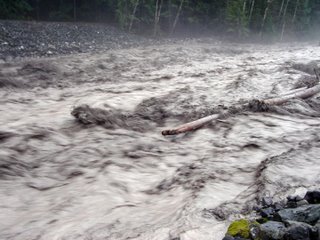
Updates: the weather observations for Paradise measured 11.3 inches in the past 24 hours! At Camp Muir, the temps hovered in the mid 30's (probably rain) but it was the wind speed that remained impressive. Gusts of 121 MPH were recorded and the average wind speed for one hour in midday was 101!! The Nisqually River (pictured right) is nothing short of a boiling chocolately torrent, as is every other creek and stream around here. The river sounds like a freight train and the ground trembles as large boulders and old-growth trees jostle into the flow. The air even smells of glacial mud, cedar and pine.

As it stands now, the NPS is evacuating any non-essential personnel from the park before the roads completely wash out. The Carbon River road is also closed, as is the rest of the park.

Monday, December 24, 2012

Going International

Looks like summertime is finally going to be with us for awhile. With nothing but sunny days in the forecast, now is the time to come out and crush the mountain! Conditions on the upper mountain are as good as they get for early July. Routes such as Liberty Ridge and the Fuhrer Finger that normally get a little thin this time of year are still holding lots of snow and should really be climbed a lot in the coming weeks.

Climbing rangers have been fairly busy over the past weeks with a number of tasks including climbing the mountain, training with the military, doing a couple of searches and rescues, and in our spare time trying to keep the toilets clean. One of the most special things that has happened in our world lately is that we have been able to host Ang Tshering Lama, a Nepalese climber, who was here as a guest ranger for three weeks in June. Ang spent time at both Camp Muir and Camp Schurman, patrolling climbing routes with rangers, taking part in our various trainings, and assisting in multiple rescues. If you were at Camp Muir or Schurman in the past few weeks you might have even caught a smell of the delicious food he cooked up for us during his stay. This is the third year in a row we have hosted Nepalese climbers in our program and we are very proud of our close relationship with their climbing community. Later this summer we will be hosting the Korean Alpine Rescue Team, so stay tuned...

Be sure to come by the Guide House up at Paradise, or one of the other ranger stations around the park, and say "hello."

Friday, December 21, 2012

Petrified Forest National Park

After leaving the Grand Canyon, I drove east on Interstate 10 to visit the Petrified Forest National Park. In order to appreciate this place, you must exit the Interstate, get out of your vehicle, and take the short walks that are available. From Interstate 10 on the north side of the park there is a road that will take you a short ways into the Painted Desert, then it turns south to take you through the Petrified Forest. It comes out on U.S. 180 east of Holbrook, where you can easily pick up the Interstate again. It may take you a couple of hours to drive through the park, but it is well worth the slight detour.

The colors in some of the pieces are incredible. It looks like someone came along with a chain saw, a very large one in some cases, and cut up the “trees” into small pieces.... then they went and tossed those pieces and scattered them around the desert floor. Of course, the Rangers deny any such thing.

Actually, the Petrified Forest, as we see it now, is but a shadow of its former self. Before it became protected as a National Park, people came and took away quite a bit of the petrified wood. Even now, with a warning of a fine of several hundred dollars, people still walk off with bits and pieces. I can understand the attraction. It is beautiful stuff and the colors are startling, but I resisted the temptation and went away empty handed, except for the photographs I took.


Starry Night in the Maple Forest


This photo was made last night when there was supposed to be a pretty good chance of seeing some Northern Lights. While the Aurora was a no-show, the stars last night were incredibly vivid, so much so that it felt like you could reach up and pluck them from the sky.

The magic of the night reminded me of my favorite quote from Vincent van Gogh:

"For my part I know nothing with any certainty, but the sight of the stars makes me dream."

Sunday, December 16, 2012

Labor Day Sun!

After a week of some pretty stormy weather up here on Rainier the sun is back out and a fresh coat of snow can be seen covering the upper mountain. Today and tomorrow are shaping up to be a great couple of days. The Emmons route is still in great late season shape and the DC is undergoing some changes, making the route a bit more difficult but motivated climbers could still find some great adventures by climbing out of Muir. We even have a very motivated lady who is currently at Muir with skis and planning on having a nice (possibly bumpy) Labor Day ski down the snowfield.


Check in with rangers at the CIC or high camps for the latest conditions. Hope everyone is enjoying their weekend!


Saturday, December 15, 2012

Roadbike Shopping Complexities

Patria's Serotta, RSC

I've mentioned before that I've been shopping around for a road/racing bike since last May, and that I hoped to write about the process once I bought one. With Spring just around the corner, I am getting emails from readers who are going through the same ordeal and feeling lost, wondering whether I plan to post a guide of some sort. The quick answer is "no." I am sorry to disappoint, but I can offer no helpful advice on this topic at the moment.


Many roadbike shopping stories I hear or receive from readers are very similar to my own experience. It starts with a decision to buy a roadbike. Nothing unusual - a fast modern roadbike for paceline rides, group rides, and so on. So at first you're thinking "Well, since I don't necessarily want anything 'lovely,' this should be easy. There are bike shops filled with roadbikes and nothing but roadbikes after all." And optimistically you head to these bike shops... only to discover that there really aren't as many options as you thought.


Most guides to buying a new roadbike will tell you that fit is the main thing, and that once you have that down everything else will fall into place. Okay. So I've been fitted by several different professionals now, with the consensus that I have fairly standard proportions for a woman of my height and that I require a road frame that is52cm x 53cm or thereabouts. It is not difficult to find a stock roadbike with these dimensions, so in theory I should be all set. In practice however, there is much more to it.


For one thing, there is the dreaded toe overlap. I do not want to spark a debate on this topic yet again, so let's just say that some cyclists dislike TCO and leave it at that. I happen to be one of those cyclists, and it is not easy to find a stock frame in a small size that does not have this issue. So even though the right frame size is easy enough to find, the right frame size with no TCO limits the pool of available bikes considerably.


But a much larger issue that tends to be glossed over in bike shops, is that roadbikes don't all handle the same and don't all have the same ride quality. These factors are important to me. I would be miserable on a bike with a harsh ride or on a bike that I cannot control on turns. Realistically, I need to test-ride a roadbike for at least 20 miles on hilly terrain in order to determine whether I am comfortable with it - essentially, I need to simulate the sort of ride I would normally be doing on the bike.And that is usually not possible.


Apparently many bike shops expect you to test ride a bicycle either in their parking lot or around the block. At most they expect a test ride to be a couple of miles. Taking a bike on an actual 20 mile ride? In my experience, only a handful of shops will allow this, and those shops tend to be high-end with expensive bikes.


An additional problem for me personally, is that I cannot use Shimano STI levers - what the vast majority of demo roadbikes in the vast majority of bike shops are fitted with. There is something about the shape of Shimano STIs that my hands don't like, and I cannot safely brake on a bike with these levers. This limits me severely on the bikes I am able to test ride, even if I am allowed to take them on a long ride.


The problem of testing before buying is also what made me wary of going custom. Framebuilders are wonderful, but no matter how much you communicate there is no guarantee that the bike they make will feel and handle as you want it to. Very few framebuilders offer demo bikes, and most of us are not lucky enough to have acquaintances whose custom bikes we can try. A blind purchase of a custom roadframe seems risky to me - especially if you are relying on it for a particular date/event and do not already have a roadbike to fall back on if something goes wrong (or takes longer than expected).


Going semi-custom, building up a stock frame from scratch, or refurbishing a vintage frame with new components, similarly involve risking the unknown, albeit at a lesser cost.


So what solution am I proposing? Well that is just the thing, I am not. Ultimately everyone will need to find their own solution and for many that will involve trial and error. Not everyone is sensitive to a bike's ride quality and handling. Not everyone cares about things like toe overlap. Individual preferences and skill levels play into it a great deal. As does simple luck. Some get lucky and buy a roadbike they are comfortable with on their first try. And reading this, they will no doubt think I am overcomplicating things. But others will face one frustration after another, and may even give up roadcycling as a result of not finding a bike they are comfortable with. If you find yourself in that category, I can only encourage you to be patient and not give up. Try to identify the problems you are having with your current bike or with the bikes you are trying in stores. It may, after all, be something as simple as trying a different brand of levers you never realised existed.

Friday, December 14, 2012

Wild Flower

I see these little wild flowers frequently out Don't know their official names.

Thursday, December 13, 2012

California:: Jalama Beach County Park

I got a late start when leaving Morro Bay on March 29th and I only went about 100 miles south. Driving along California Highway 1 near Lompoc, in Santa Barbara County, I noticed a sign for Jalama Beach County Park. It had a campground and I needed a place to stay for the night.

It was somewhat challenging to get to. The sign showed that it was 14 miles down a county road. Wow! What a drive. Talk about a winding road and hilly! After about the first two miles I was ready to turn back, but there was no place to safely turn around, so I continued on. It was definitely worth the drive though...

It was a rocky, sandy beach.

Late afternoon and the fog started rolling in toward the shore.

I had forgotten that there was a railroad along the coast. This bridge was on the north side of the campground. Several passenger trains came through while I was there.

It was extremely windy that day. The two fellows in the background are kite surfing. It was amazing how they jumped the waves and moved in and out along the shore.

They did occasionally fall off their boards, but quickly retrieved them and went back out for more.

Heavy fog was on its way and the kite surfers were still having fun. So am I.

A Quick and Healthy Diet

Peppy & Brompton Shopper
I don't usually pay attention to my weight unless I start to feel uncomfortable. Well, a week ago that day came. I've been super busy and not riding as much as I'd like over the past month, without changing my eating habits to accommodate. It was fine for a while, until one day I got on the bike and... well, let's just say I felt my tummy jiggle and fold in on itself as I pedaled. It was disconcerting. So I decided to go on a diet and get myself to a state of feeling comfortable again. The healthiest version of a crash diet I know is a low-carb, high fiber, high nutrition diet. It works extremely well, because in addition to making you eat healthier it also acts as an appetite suppressor. Here are the rules for anyone interested:


Things to cut out completely:

alcohol, sweets, junk food, bread, pasta, potatoes, rice, soda, most juices


Things to eat:

vegetables, lentils, nuts, eggs, milk, fish and meat (or tofu and quorn),high-fiber oatmeal, apples, berries, cheese, butter, unsweetened carrot and cranberry juice


How much to eat:

For a woman my size not engaged in strenuous exercise, around 1,200 calories a day will work. But this is ballpark; adjust for size/gender/exercise level. Go heavy on the vegetables, light on the fatty stuff, and medium on the protein.


How long will it take?

I see results in 1-2 weeks when I follow this strictly.


Sample Day's Menu:

breakfast:

oatmeal with butter and blueberries

lunch:

steamed spinach with sesame seeds and sliced almonds

dinner:

grilled salmon and asparagus, lentil soup

snacks:

apple, nuts, broccoli florets, baby carrots, coffee and tea with milk


So... I have been doing this for 5 days now. It was difficult on the first two days, then it got much easier. The fiber, the reduced carbohydrates, and the elimination of alcohol are the key here. I already feel a difference and in another week my body should be back to normal. Then I will have a good look at my schedule and try to get more riding in, so that I can eat whatever I want again (kidding, I will try to generally eat healthy from now on is what I meant to say)...

Wednesday, December 12, 2012

What Happens to a Tree

We go to the mountains and cut firewood every fall to use in our wood burning stove over the winter. The first photos show the trees as they look while growing.


The next photos show the tree after it dies. So why does it die? No one really knows why one tree dies and the ones next to it don't. Maybe it didn't get enough water. Maybe to much. Maybe it was struck my lightning or burned in a fire. Or just lived out it's life span. This one was a aspen tree. After it died the upper part fell off.


Then someone comes along and cuts up the part laying on the ground. Rules say you can only get the 'dead and down' wood. The part that was still standing we arn't allowed to take. Many birds and other wildlife could use it.


Then the chunks of wood are loaded into a pickup and brought home.


Here is a photo of the pile of wood after it thrown off the pickup and then we split it with the log splitter, (we are to old for using an ax any more) and afterward it will be stacked in the wood shed so it won't get wet if it should rain or snow. (you can see the woodshed behind the wood pile)


If a piece of wood is very lucky it will not be burned. If it looks like a good piece that can be turned into something pretty on the lathe that is what happens. This piece will be a vase eventually. It was still to green to finish at this point. It will have to dry for a while before being sanded and a finish put on it.


Saturday, December 8, 2012

Phend-Fisher Family Reunion Ledger - 1914

The Phend-Fisher families gathered for a reunion in Elkhart County, Indiana almost annually from 1909 until 1943. Usually held at Nappanee, the events of the day were recorded in an old ledger book. Spelling has been retained as it was in the original though some punctuation and paragraph breaks have been added. To view all articles in this series click on the "Phend-Fisher Reunion Ledger" label at the bottom of this post.

June 25, 1914
the sixth reunion.

The Fisher reunion was held at McNaughton park in Elkhart. in which their were about 40 present. dinner was served on tables under the trees, near the river. their being no program.

Officers were elected as follows
C. D. Phend. Nappanee Pres[ident]
J. J. Phend Bremen Vice [President]
Mr and Mrs Frank Wehrly Nap[panee] Secrethry

No Births.

Katherine Phend and Rueben Pletcher
Surelda Phend and Barton Thornton
Evelyn Fuller and Walter Shaw.
married.

Samuel Fisher died.
Mrs John Ringenberger died

Battle at Little Bighorn

Sunday, August 28th - - 135 years ago, late in the afternoon of Sunday June 25th, a battle took place here that has been mired in controversy ever since. It was in this area that 210 men in five companies of the Seventh U.S. Cavalry were killed in action by Lakota (Sioux), Cheyenne, and Arapaho warriors.


“Custer's Last Stand” took place on this hillside where 42 of those 210 men, including George Armstrong Custer, lost their lives. There was supposed to be a three-prong attack but the other two columns of soldiers were delayed. In other skirmishes in the area that day and the next, an additional 58 soldiers and Indian Scouts were killed. It was called the Battle of Little Bighorn by the United States and Battle of the Greasy Grass by the Lakota (Sioux), Northern Cheyenne and Arapaho people.


Custer vastly underestimated the size of the Indian encampment in the valley below; it numbered in the thousands though not all were warriors, there were many women and children as well as older men. (Figures I've seen at various websites put the number anywhere between 6,000 and 12,000 Native Americans camped in the valley.) Thinking that his troops had been discovered, Custer felt that the element of surprise had been lost and that the Indians would quickly leave their camps. So he attacked, splitting his troops in an attempt to surround the encampment. Obviously, that didn't work!


In about a five mile stretch, along the ridges and in the gulleys, the spots where soldiers and some of the Indian Warriors were killed are identified with markers, although in most cases, not with specific names.


Many of the soldiers and the Indian Scouts were mutilated and scalped. However, Custer was not. Some say it was because he was dressed in buckskins rather than a uniform; he had been shot in the temple and in the left chest.


At the top of the hill where Custer made his “last stand” is the memorial to the soldiers and Indian Scouts who lost their lives during the two days of fighting. Their names are inscribed on the sides of the monument.


It is estimated that about 60 Indian Warriors were killed in the fighting. The spots where 14 of them were killed have been identified with reddish-brown markers. These two are for Cheyenne Warriors “Hahpehe'Onahe” aka Closed Hand and “A'Kavehe'Onahe” aka Limber Bones who “fell here on June 25, 1876 while defending the Cheyenne way of life”.


The Battlefield is dotted with interpretive signs that help in understanding what took place and when. This sign is across the road from the memorial to the fallen soldiers. The visitor center also has a 17-minute video and park Rangers give a 20-minute talk every half hour or so. The video and talks are quite interesting.


Across the road and a short distance from the memorial to the soldiers, is the Indian memorial, which was authorized in 1991 along with a law that changed the name from Custer Battlefield National Monument to Little Bighorn Battlefield National Monument. A large circular area contains the above sculpture as well as a wall of displays embedded in black granite. It was quite impressive and very informative, presenting just a little bit of the battle from the perspective of the Native Americans.


A detail of the sculpture.


Some of the Indian Scouts in the employ of the U.S. Army and with the 7th Cavalry were members of the Crow nation. The Crow considered the Lakota, Cheyenne, and Arapaho people to be their enemies because, among other things, the Sioux tribes were encroaching on what had traditionally been Crow territory.


The panel above depicts the scene of the Battle of The Greasy Grass as drawn by White Bird of the Northern Cheyenne.


On August 10, 1983 a prairie fire swept over the battlefield, burning nearly 600 acres of dense, thick vegetation. For five weeks in May and June of 1984 the National Park Service conducted a systematic archeological survey of the battlefield. They recovered 1,159 artifacts including arrow heads, bullets, cartridges, buttons, coins, soldier skeletal remains, boots, military and horse equipment, and personal items of soldiers and warriors. Archeological evidence, used in conjunction with accounts of the battle participants and placement of soldier bodies help in reconstructing the battle. Additional archeological surveys were conducted in later years and will continue in the future.


A four mile drive along the ridges of the battlefield provides some idea of the extent of the battle and the challenges wrought by the terrain.


The markers for an Interpreter Guide “Neesirapat” aka Bloody Knife and two Indian Scouts “Hukos-ta-rikus” aka Sgt Bobtail Bull and “Naahukoos Ciripaslt” aka Little Brave who fell here “while defending the Arikara way of life”.


Much has been written about the Battle of Little Bighorn with various interpretations of the events leading up to the battle and of what actually occurred during the battle – just do a search for it and I'm sure you'll come up with quite a variety of websites! It seems that History is always open to new interpretations, so regardless of your own feelings and ideas of what happened here I'm also sure you will learn something new - I know I did!