Thursday, February 28, 2013

The Closest Thing to a Valentine

In all of the photo albums and family papers of my grandmother's, I haven't come across any valentines or love letters written by or to anyone. None. Zilch. Nada. And I don't have any personal valentines (that I'd care to share). So with my birthday being just 3 days after Valentines Day, I thought these cards might be good substitutes for inclusion in the 20th edition of Smile For The Camera. My niece Carrie made them a “few” years ago (when she was 9 or 10 years old). The images were previously published here on kinexxions in July ...


Tuesday, February 26, 2013

Injured hikers airlifted from Camp Muir with help of Army Reserve team

Here is the NPS press release about the recent incident on the Muir Snowfield. We'll attempt to put more information online when we can.

Injured hikers airlifted from Camp Muir with help of Army Reserve team


Two hikers suffering from hypothermia and frostbite were airlifted from Camp Muir on Mount Rainier at 6:15 this morning, with the help of a Chinook helicopter operated by members of the Army Reserve’s 159th Aviation Regiment at Fort Lewis. They were taken to Madigan Hospital and from there by ground transportation to Harborview Medical Center in Seattle.

The injured hikers were Mrs.Mariana Burceag and Mr. Daniel Vlad of Bellevue, Washington. A third hiker, Mr. Eduard Burceag, the husband of Mrs. Burceag, died of injuries sustained in the incident. His body is being removed off the mountain this afternoon.

The three individuals are experienced mountaineers who had visited Camp Muir in the past and have enjoyed hiking and climbing on Mount Rainier for many years. Two had previously reached the summit. On Monday afternoon, they became trapped on the Muir Snowfield by a sudden blizzard while descending from a day hike to Camp Muir. Early Tuesday morning a 911 emergency call came through to park rangers advising them of overdue hikers on the Muir snowfield. Due to heavy, drifting snow, seventy miles per hour winds, and near zero visibility, a rescue team was unable to safely initiate a search at that time. At about 7:15am, one member of the party found his way to Camp Muir and was able to direct a search team, made up of climbing guides and park rangers stationed at Camp Muir, to the party’s location near Anvil Rock. All three of the stranded hikers were under shelter by 8:30am. Three doctors, who were at Camp Muir as clients of one of the park’s guide services, provided immediate medical care. Mr. Burceag was unconscious and unresponsive upon arrival. Rescuers were unable to revive him.

The shelter at Camp Muir is warm, dry, and well-stocked with food and water. A carry-out rescue could have been initiated following the rescue, however, rangers and doctors determined it would be in the best interest of the patients to spend the night and wait for a break in the weather to safely fly the next day. This morning dawned clear above Camp Muir, with heavy clouds below. The Chinook helicopter arrived at 6am and, in approximately 15 minutes, lifted Mrs. Burceag and Mr. Vlad, along with one of the park’s climbing rangers, into the helicopter by hoist and cable. Those on scene report that the cloud ceiling had risen somewhat by the time the helicopter arrived, and that the rescue occurred amid swirling clouds that threatened to engulf the mountain in fog.

The Chinook helicopter was operated by members of the U.S. Army Reserve, “A” Company, 5th Battalion, 159th Aviation Regiment at Fort Lewis, Washington. [Note: Yesterday’s press release attributing the helicopter to the 101st Airborne Division was incorrect.] This reserve unit has worked with park officials at Mount Rainier on numerous rescues over the years, and has been invaluable as a backup resource when private vendors are unavailable or lack the capabilities required by the mission. In this case, for instance, the Chinook was able to fly out of Fort Lewis by instruments, despite the low clouds and poor visibility that grounded commercial helicopters. Over the years, the Reserve unit’s helicopter has been modified in several ways to accommodate the needs of Mount Rainier’s climbers: with a fixed line inside the aircraft for climbers to clip into; with removable plywood flooring to accommodate climbers’ crampons; with a special hoist for lifting individuals into the helicopter; and with flight helmets for use by park rangers, outfitted with avionics for communicating with the helicopter team.

Every year, roughly 9,000 people climb Mount Rainier and only about half of them reach the summit. Thousands more take day hikes or overnight camping trips to Camp Muir (48 were registered there on Tuesday night). These individuals are attracted by the majesty of the mountain, the wilderness experience, and the breathtaking beauty of mornings like this one, high above the clouds on the side of the volcano. Like many things in life, there are inherent risks in the wilderness. Sudden storms like Monday’s blizzard can catch even the most experienced and prepared hikers off guard. Visitors should check in with park rangers for the latest information about conditions on the mountain, and should always be prepared for an emergency.

~ NPS

Monday, February 25, 2013

The "new" alpine ice boots?

These are all newto me and the blog anyway. After all the blog is suppose to about alpine ice and winter climbing. Not the foo-foo world of skiing :) Some really good boots available these days for cold weather climbing. The key is finding the one pair that fits YOU the best! Hopefully I'll be able to shed some light on that part of the process with the up coming reviews, weightsand comparisons.


A fewof the boots here now or coming shortlyfor reviews. I can do better than the stock pictures I pulled off the net this morning :)


Zamberlan

3000 PAINE PLUS GTX RR


4000 EIGER RR


6000 DENALI RR


Asolo


EIGER


La Sportiva Nepal Cube


Mammut Nordwand TL


Lowa 6000


and the newest Lowa 6000 below


Lowa Katok XT


Salewa Pro Guide


Scarpa Rebel Pro


Monday, February 18, 2013

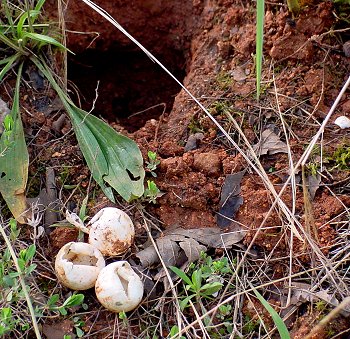
Turtle egg mystery

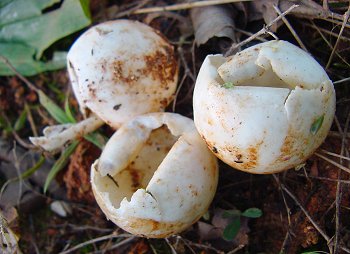
Near the pond, a critter unearthed and feasted on turtle eggs. The evidence was originally scattered several feet from the hole - I gathered a few of the shells back together for a picture.


Eggs in another nest nearby suffered a similar fate. I'm guessing that the culprit was a raccoon, skunk or opossum, but other turtle egg predators apparently include the fox, armadillo, mink, otter, and weasel.


I tried figuring out which species of turtle these eggs had belonged to, but didn't get very far. Here's where the (as yet to be invented) portable DNA analyzer would have come in so handy.

Several species can be ruled out since the eggs were spherical rather than elliptical, but other than that I couldn't find any key to turtle egg identification.

The eggs may have belonged to one of the two snapping turtles I saw recently, although they seem a bit small for that (not quite ping-pong ball size).


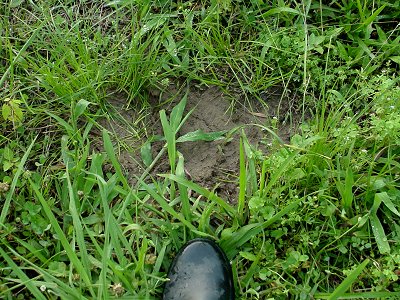
Undisturbed turtle nest.

In researching the turtle egg mystery, I came across an interesting story about a snapping turtle hatchling at the Hilton Pond site, where nest building is also discussed.

And found some more great snapping turtle pictures. (Eating a snake! Eating a fish!)

Even more good snapping turtle info.

Jemez Springs Church


When we came back through Jemez Springs we stopped at this gift shop (which was closed) as the pink flowers on the flowering plum tree in front of the church caught my eye. You can see how close to the main street of the town the church is. Not sure how old this church is but think from the 1940's or there about.


I can stretch my wings just like Mom and Dad!


This evening I made it back up to visit the Loons for the first time since the morning of July 19th. The chicks have grown quite a bit in that time! Their diving times have gone from lasting only 2 or 3 seconds to about 20 seconds. They also seem to be stretching their wings a bit more than a week ago. This is hands-down my favorite image of the evening!


Above: “They sure do grow fast!" - This Loon chick, just one day shy of being two weeks old, is already twice the size it was a week ago.


Above: "Sparkling Loon" - A Loon chick swims across the lake while the water sparkles all around it in the morning light.


Friday, February 15, 2013

Let it snow, let it snow!

As y'all know, Northern Indiana and the Midwest got hit by a snowstorm yesterday. According to the local weather people Whitley county got about 10" and Noble county (where I live) got about 12". I just talked to my brother and he measured the snow in his back yard (in a woods in Kosciusko county where little wind gets to it) and he says they got 15" of snow.

For me, the issue isn't the amount of snow but rather the wind. It whips around the buildings in the complex where I live and causes large drifts. Below is the view from my front window, the first one taken at 10 a.m. and the other at 1 p.m.


The window is about 18" off the ground and the snow is packed onto the front porch. The drift on the outer edge is about 3-3 1/2 feet high. It runs clear across the driveway too. If I get energetic I might go out and shovel a bit this afternoon. Or I might just wait until the maintenance people come and let them shovel it out. My neighbors were out for a while and cleared off their porch and drive.

The delicate lines of the snowdrift outside my front door. It is about 3-3 1/2 feet high.


The view from my front door. Looking south, then looking west.


The sun started breaking through the clouds a little before noon. The day is shiny and bright. And I'm glad I don't have to go out in the cold wind and drifting snow.

Wednesday, February 13, 2013

Long Commutes in the Rain

Brompton Rain Riding

Most transportation cyclists eventually get comfortable with riding in the rain, and for me this was never particularly a problem. In the beginning, my commutes through the city were short and I mainly remember struggling with poor visibility and chaotic traffic, before getting used to it all. But as my travel radius increased, so did my exposure to rain. Some things began to matter that did not matter as much before, and I gradually made adjustments.


Brompton Rain Riding

As far as the bike, the big thing for me was waterproofing. I carry a laptop always when cycling for transportation, a DSLR camera much of the time, and also hand-written documents. These items absolutely cannot get wet. While there is now a wealth of attractive new bicycle bags on the market, many of them are not designed to resist water beyond a short ride. For long commutes, I suggest using a touring-grade bag or one that is specifically described as waterproof. The Carradice I've been using on my Brompton for the past 5 months has been pretty good so far (for as long as 50 miles in continuous rain in Ireland - with both my laptop and camera inside), as was the Po Campo pannier I used on my full-sized bikes before that. Ortlieb bags are probably an even safer bet. Just in case, I keep a plastic bag inside for emergencies, and I always store water-sensitive items in internal compartments.


Brompton Rain Riding

An issue for those who use leather saddles, is that these can get soggy (and, consequently, deformed) after long rides in the rain. A good saddle cover helps, and the stock one from from Brooks shown here is actually not the best example. Normally I use a thick gray one from Rivendell that fits tightly all around the saddle. It is deep, too, which protects the underside of the saddle as well. I am sure there are others that do a good job. Alternatively, there are specially treated leather saddles - such as Selle Anatomica - that claim to be waterproof.


Brompton Rain Riding

Finally, long exposure to rain might call for additional bike maintenance. On a bicycle without a chaincase, lubing the chain is probably a good idea. And even if you're not into cleaning your bike, the debris that gathers around the brake calipers and derailleur is worth wiping off to keep everything functioning smoothly. The need for this kind of maintenance after long rides in a downpour certainly makes a good argument for internally geared hubs, enclosed hub brakes and a full chaincase. However, bikes with those features may not be ideal for hilly long distance commutes.


Brompton Rain Riding

As far as the cyclist, clothing choices get trickier - especially if you want to ride in regular clothes and don't have the opportunity to change upon arrival. A truly waterproof outer layer is essential. But equally important is breathability, since you are exerting yourself more than you would on a shorter ride. When I started riding longer distances I discovered that my usual raincoat was neither entirely waterproof, nor very breathable. Eventually I found one that worked well - made of light, technical fabric with lots of vents and a removable hood. Rain capes may be another option, with some breathable, cinchable ones from Iva Jean and Cleverhoods recently introduced. Just as crucial as outerwear is waterproof footwear: Shoes that are fine on short rides can get soggy after 10+ miles pedaling in the rain,and you probably don't want to sit around with wet feet all day.


Of course, all the general tips for riding in the rain still apply: Lights, fenders, extra caution. On an upright bike, I don't feel like the rain is hitting me in the face as hard as it does on a roadbike, which makes things more pleasant.Once outside the city, I generally find it fairly peaceful and low-stress. Mixing ideas from transportation cycling and touring has been helpful for me and that's what I would suggest to others with long rainy commutes. Find a setup that works for you, and enjoy not being stuck in suburban rain-day traffic!

Tuesday, February 12, 2013

It is the Eiger, who needs an excuse!

http://www.climbing.com/exclusive/features/blankcheck/


One of my favorite Jonny Copp stories.


Eiger North Face HMG from Dan Goodwin on Vimeo.

Monday, February 11, 2013

The season is underway... sort of

Hello again winter fanatics. Hope everyone had a great spring, summer and fall. My faithful climbing partner/girlfriend Larua and I have been out dry tool training and scoping things out for the upcoming winter season. Great News... We think we've found the largest concentration of moderate ice climbs in Western PA. As the weather gets better (worsens) we'll be able to tell you more. It could be home to over 20+ WI3 to WI4 routes. We've also been eyeing up some new mixed lines that are begging to be climbed. It should be a good year full of new routes. We've been getting our workout on as much as possible. Laura has come out swinging! getting early season clean ascents of routes most local "dudes" won't even try. The start of things freezing is (hopefully) a few short weeks away. The woods and cliffs are dripping plenty and all the water looks promising for an incredible year. We didn't rock climb a whole lot this summer, but we did keep our tools veryactive during the winter "off" season April-November dry tooling as much as possible.


I figure there is no reason to bore everyone with long tales of my off season activities, so I'll sum it up in a few sentences. I spent the spring and summer running... Mostly trails, but also some pavement running with a few races thrown in for good measure. I managed to do quite well across the disciplines. My true love of running is long distance in the woods for many hours at a time. Below is a photo that Laura took during a HOT summer run. She had it set on our computers wallpaper for most of the season. It shows me in all my glory during a run on the Laurel Highlands Hiking Trail. I usually spend 5 days a week training on this 70 mile point to point trail. Its a short distance from our house to the trail which makes training convenient. On the trail I've adopted the name "woodz ninja" although below I look more like "Salt Pig Sweat Hog" It definately keeps me in shape for winter climbing. Laura spent the majority of the off season hiking a lot and volunteering at Powdermill Nature Reserve in Rector, PA. She helped in the bird banding lab.


Around mile 50 or 60 in 90° humid summer

weatherat one of our "Mobile Aid Stations"
The other hobby I enjoy is hawk watching. Unfamiliar with it? It's more like the counting, study and observing of migrating raptors for scientific purpose. In particular I've been interested in the migration habits and paths of the Golden Eagle through the central Appalachian chain. Every year in mid September I slow climbing "training" and start hawk watching for a few months. This upcoming spring season I am starting the first official hawk watch in Western MD. If you have any interest or would like to learn more check out my blog for the Cumberland Gap Hawk Watch. It'll explain a great deal. If you have any questions please get in touch. As climbers we spend a great deal of time in raptor territory and being able to identify and understand these amazing birds soaring around the crags is well... pretty awesome!


Another recent project I helped with involved former PA ice climber Rob "Griz" Ginieczki author of the 2006 climbing guide titledIce Climbing Pennsylvania. Much has changed in PA climbing since 2006 and it was time for an update. Griz approached me to help with the Southwestern PA section. Personally I can say quite a bit has been added to the SWPA section and should help everyone climb even more ice in our region. The book is in print right now and should be out in time for this season. I'll keep you posted as to when they are available. Great job Griz! Keep the PA ice community stoked and getting after it!


Stay tuned as the winter progresses and the climbing starts to happen. I'll be posting regularly again keeping ya'll updated on the happenings around here. Train on! -Tim

Alenax: the Ultimate Vintage Freak Bike?

Alenax Transbar Power

Looking for the perfect bike for that End of the World themed ride? I think I found it. Having seen so many crazy two-wheeled contraptions in the basements and garages of collectors over the years, I sometimes think that I've seen it all and that no bike can really surprise me anymore. And that's usually when I'll stumble upon something like this. Notice anything out of the ordinary?


Alenax Transbar Power
How about now?


Alenax Transbar Power

Meet theAlenax TRB 2400, the original Transbar Power bicycle. It was designed to be pedaled using up-and-down motions instead of circular motions. Presumably this was done to approximate the feel of walking, thereby making cycling feel more "natural." Here is a video of this in action.


Alenax Transbar Power

In leu of a crankset, the Alenax sports two pivoted "transbars." I won't pretend to understand how exactly the system works, but seethis articleby Jobst Brandt andthe Alenax blogfor additional descriptions.


Alenax Transbar Power

A stem-mounted shifter controls the gears


Alenax Transbar Power

- on Alenax's own internally geared hub.


Alenax Transbar Power
Abundance of cables and chains along the drivetrain.


Alenax Transbar Power

But aside from the pedaling system, the Alenax looks disconcertingly normal. Lugs, skinny tubes, shimmery paint, tan wall tires. It's basically just a typical '80s roadbike, retrofitted to accommodate the Transbar Power system. It is also a good 5lb heavier that a standard roadbike from that era.


Alenax Transbar Power

When Alenax came out with these bikes in 1983, they marketed aggressively, intending to revolutionise bicycle design. They attended all the bike shows, made promotional videos, courted distributors. But amazingly, the concept failed to catch on. By 1993 they threw in the towel, and all that's left today are the (apparently highly collectible) traces of their efforts. At some point more recently, it looks like there was an attempt to modernise and rebrand, but that too does not seem to have worked out.


Alenax Transbar Power

I am doing some freelance work for Harris Cyclery, and one of the perks is getting to see things like this. Jon Harris dragged the Alenax out of the shop's basement one day, then proceeded to ride it jauntily up and down the block. "It feels a little strange until you get it up to speed," he explained, "but after that it's fine!" The bike is too big for me to ride, so I cannot confirm that. But they do have a partially assembled step-through version in the basement...