Thursday, October 31, 2013

Ohiopyle (Meadow Run) Conditions

Today I stopped to check conditions at Lower and Upper Meadow Run today. Overall, Lower Meadow is looking bleak. The short supply of ground water is keeping the ice from forming here. Good news is that there IS ice forming on the start to an awesome looking route that I've tried several times over the years. Its in the middle of the overhang between Anger Management (L) and Captain Caveman (R). It comes out the steepest, longest part of the roof. The seep coming down the short face below the roof is almost ready for some action. I think by next week this line will be ready to try. Please don't knock down the icicle that is almost connected to the Rhodie. This is the start to the route.


Just about ready to go. Next weeks line?
The rest of the lines are looking thin, but as you can see in the picture, the finish to Anger Management is looking great for any aspiring senders. Now is the best time to do it. Captain Caveman is also in great condition, but the extension hanger isn't formed up enough to support body weight. Soon enough.

Hemlock is looking thin, but climbable after a thin start.


Walking up to the thin start of Hemlock WI3
The Main pillar is in horrible shape for the amount of cold that we've had. I wouldn't recommend it to anyone at this point. Don't waste your time if you're planning on coming here to climb the normal ice lines, they don't exist yet.

On a positive note. Upper Meadow Run is looking very good so far. The School Yard has a very nice flow for most everyone. Its forming an nice gully runnel just to the right of the normal ice lines. It appears to be thick enough for any length screws. Get it while its good. Here's a photo of School Yard area.


The "NEW" right runnel that usually doesn't form
The steep mixed climbs in the cave are good for dry tooling, but the ice doesn't appear to be long enough for body weight or use. So if you're into the upside down antics give it a little more time and they should be good for some tries. Above all, the best part of climbing at Upper Meadow is how beautiful the area is. Come out to Southwestern PA for some great winter climbing.


The beautiful setting at Upper Meadow Run with the Amphitheater on the right


Another photo looking out of the cave

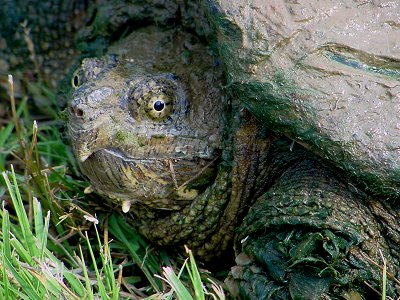
Another snappy visitor


Last week Jasmine started barking like a crazy dog again. "There's an alien reptile here! Right here! Right here! Right here!"

This time I had to tie her up at a safe distance, since the turtle was jumping at her. Jumping and snapping. I've never seen a turtle move so fast.

If this is the standard for snapping turtle behavior, there really must have been something wrong with April's slow-moving visitor.

The new guy was a little smaller, decked out in about an inch of mud, and feeling very lively.

How to get a fiesty turtle out of a dog's range?

I'd heard stories of snappers grabbing a stick and holding on til sundown. He'd grab it all right, but would let go the moment I tried to lift him up. Didn't take too well to being herded with the stick either. (Got to see him jump at warp speed again though.) I eventually scooped him up with a long-handled shovel and relocated him to the other side of the fence. Heavy little sucker.


I found a site with pictures showing the difference between common snapping turtles (Chelydra serpentina) and alligator snapping turtles (Macroclemys temmincki). They show our visitor to be the former.

Tuesday, October 29, 2013

Blue Skies from Pain


What is it like to ride here? I never quite know what to say. Because, you see, it is so distinct, and at the same time it is more about a feeling than about the landscape or the weather or the road conditions. If I close my eyes and try to evoke the experience of it, the thing that comes to mind is tunnels. The winding narrow farm roads with their tall hedges form a mazeat the edge of the Sperrin mountains, and navigating through it - always climbing or descending, always either going around a bend or just about to - is a unique form of meditation.There is a pressure and an intense concentration to it, and at the same time a release and a complete lack of focus.


The back roads here have some peculiarities, and one of them is the reverse dip. The road is convex, with the center forming a ridge and the sides sloping down toward the gutters. I have heard several explanations for why this is so. One is that the roads were made this way to begin with, to facilitate drainage. Another is that heavy farm machinery has deformed the surface over the years. Whatever the reason, one soon learns to keep off that central ridge - in particular while descending. The ridge is wide enough for a tire, but there is something wrong there - a slickness, or maybe some Twilight Zone force - that makes the bike behave unpredictably should you allow it to drift to the center of the road while cornering sloppily. This adds an extra layer of excitement to the already wild descents.


One of the things I love about Northern Ireland is the weather. People laugh when I tell them this, but I am not joking. Both physically and mentally I thrive in these damp, chilly, overcast conditions, under these temperamental skies. When I cycle over the mountain with the dark clouds so low I can almost touch them, and the mist so palpable the moisture gathers on my face, I can feel my mind emptied and my emotional palate cleansed and my limbs gone weightless and free. The road and I dip and rise and twist together, maybe even breathe together.Everything is at peace with everything else as I float, painlessly, through and over and under it all.None of this happens in the sunshine. It just doesn't. And so on warm sunny days I will, more likely than not, have a rest from the bike.


Yesterday was such a day, and in the morning I was walking home along a footpath through a wheat field at the back of the village. In the distance a tractor circled. Moving slowly and with an air of purpose, it gobbled up loose piles of hay, spitting out perfect round bales. The farmer was literally making hay while the sun shone, and maybe it was the scorching 20°C heat gone to my head after a week of bleak winter weather, but this realisation hit me so profoundly that I had to sit down to really take it in. I leaned my back against one of the hay bales, which was heavy and enormous and rough-textured. Then I went on a mountain bike ride through the forest, seeking shade and that soothing feeling I get from a place where everything is covered in moss.


On an overcast day, sometimes the sky will be dark down low, with patches of bright blue peeking out up higher. One afternoon I was pedaling up a tedious climb through a tunnel-like road and, about 6 miles in, just when I thought it was over I went around yet another bend only to find that the pitch grew steeper still. As I felt the intense pain in my legs, I looked up over the wall-like hedge and was blinded by a bright cerulean opening in the cloud cover. A light at the end of the tunnel.

Monday, October 28, 2013

Good Skiing and Narada Falls Face Snow Pit

Howdy Everyone!


Afterseveral daysof cooler weather and some precipitation, the mountain has come back out in full sunshine with a good 6" of powder on her flanks. There is some great skiing on the south and west aspects right now; while the eastern aspects are getting crusty.


This weeks snow pit was dug at the top of Narada Falls Face, just below the Steven's Canyon Road. As you can see from the profile, the main layer of concern is between 10 to 20 cm below the surface. Some moderate failuresfor the stability tests indicated that point releases are possible especially on lee slopes. However, no propagation was observed during the stability testing.


CTM(14) @ 12 cm Q3

ECTN(18) @ 12 cm Q3

RB3 @ 12 cm Q2


Keep an eye out for possible point releases on south facing aspects...there's plenty of sluffs coming off all around the Paradise area; especially the face onPanorama Point and the 4th Crossing area.

Sunday, October 27, 2013

Daylily garden


I knew, in a theoretical kind of way, that there were a lot of varieties of Daylilies. It didn't really prevent my non-stop gaping at a Daylily garden, though.


One of our wildflower group couples gave us a tour of their garden this week.


Their main focus is Daylilies -- they have hundreds of them.


I doubt I'll ever be as dedicated a gardener.


But I'm lucky to have friends who are.


All the types were labeled, but non-dedicated non-gardener that I am, I didn't take down any names.


If you're dying to know about any particular one, I can probably find out.

-----

Daylilies are Hemerocallis sp. The name in Greek is a combination of Hemera (day) and Kallos (beautiful).

I wrote about words using Kallos before, when talking about Beautyberry. Every time I come across it in a botanical name, I still crack up, remembering that comment about a track team and their cry of "Callipygious!"

Friday, October 25, 2013

Lee & Tuffee


Lee and Tuffee with Albuquerque down below them.

"Time Warp and Ice Gear"

I wrote this back on 2/20/08 onour local climbing forum. That winter was the first year I climbedwith a pair of Nomics. Not much has changedin the last 5 years that I can tell really. Head lamps have gotten better. Boots marginally so but nothing earth shaking. Clothes have gotten warmer and lighter. But some of this seemed like a real revelation 5 years ago. Umbilicals and leashless toolsare common now. They weren't well received by all 5 years ago. Most of all I am just glad I finally got off the couch again! It hasbeen a fun ride.


Hopefully beginner and intermediate ice climbers and aspiring technical climbers in an alpine environment will find the info and opinions to follow helpful. Nothing new here. Twight and Gadd cover it all much better in their respective books. The two books compliment each other. Buy them. Twight’s “Extreme Alpinism” has the best coverage of the details. His book is the “required read”. Gadd takes up the technical discussion from where Twight ended. I’ve reread both in the last month several times and gleaned other's suggestions for the Internet to try out. Gear choices are constantly being out dated. Good gear makes climbing easier...and safer.


I have little time for the guys who have opinions but have yet to have btdt. So a little back ground, and still enough ego to share an opinion. Back in the late ‘70s and early ‘80s I was fortunate enough to climb a few routes that are still considered worthy accomplishments. In no special order, the 2nd ascent of Slipstream, mid January, in 7hrs with a car to car time of 14 hr. r/t and a walk down the Athabasca. An early one day ascent of Polar Circus with 3 more ascents of the route by 1982. 2nd solo of the Becky route on Edith Cavell taking a direct line up the climb from the car door, 7hrs from lacing up my boots to the summit cross down climbing the East Ridge and back for lunch. A new route on N face of Temple. The 2nd ascent of Super Couloir on Deltaform, in a storm, via the original finish. Other water fall routes like Upper weeping wall (twice), Pilsner, Carlsberg (a couple of times), Takakkaw, Borgeau LF, among many.


So nothing horrendous even by the standards 20 years ago and light years behind stuff being done today. But climbs many guys are still aspiring to as they gain confidence and skilltoday.


By ’85 I wasn’t really climbing much ice. I was doing a lot of trad climbing up to .12b. Sport routes held little interest for me. I found other hobbies and work too committing. Climbing began to take a back seat after living that life style for 20 years. At some point I realized I wasn’t climbing at all. Not climbing rock, ice or mountains! That went on for too many years.


Then in Jan '08, a full 20 years later, I'm was dragged into Canada for ice, cold turkey, off the couch.


Past 50 years old (trust me that sounds older to me than it does to you) I at least have the means to generally buy what ever I wanted for gear. Yes, time will even solve the major problem of most every dirt bag climber \:\), even this one.


I bought into the Schoeller revolution. I had a pair of stretch European salopettesfrom the '80s that I last guided and heli skied in so I knew that was the right track. Bought the Arcteryx soft shell MX top and bottoms in several weights. More on that later. Also bought a new set of tools, a buddy gave me a set of newer crampons (more later on the subject as well) and off I went. Fat, dumb and if not happy at least excited to be climbing ice again.


Avalanche conditions in Canada this winter could hardly be worse. We started off on Louise. It is cold, I mean –30C cold. I have fewer clothes on than I have ever climbed in. I have the lightest gloves on I have ever used for winter ice and the most flexible ankles in lwt boots that I could image. I hate that damn pillar no matter how many times I have climbed it (over a dozen). But with this gear Louise’s pillar is the easiest I ever seen it.


The next 14 days of ice and mixed climbing were a real education thanks to my many old and new partners and mentors willing to put up with me.


OK, here are “MY” opinions. Not every one will share them. Remember everyone has one and you too are welcome to yours here.


After a full two weeks of climbing in everything from a pissing down NW rain, a snow storm dropping 6” in an hr, and down to –30C with hallowing wind I can say hard shell clothing is obsolete for technical climbing short of some really horrendous conditions I can’t actually image being out in. And with 7 trips to the Alaska Range I can image some pretty shitting conditions. My suggestion? Buy the lightest weight, most stretchy garments and learn to climb in what Twight calls his “action suit”. If it aint got a hood that will go over a helmet easily don’t buy it.


Only caveat to that is your base layer. You might want to think about putting some wool next to your body and a light synthetic layer/s over it. Add hoods that will go under and over your a helmet. The “R” series Patagonia hoody or the really simple Nike hoody (which I like even better for cold weather) works well. Thumb loops on the sleeves have been around 30 years at least and are really cool features in cold weather BTW.


Gloves?

Always take a few pair in the pack or pocket. At least one pair specifically for when it gets really cold from a change in weather, your exhaustion or a long, cold belay. Depending on the climb I will use a thick glove or a mitten. You'll want to error on the side of caution when choosing the “big” glove. You don’t want to pull out the ‘big ‘uns” and find you still are not warm enough and screwed. Heat packs are a good option to carry as well. Remember hydration and calorie intake are as important or more so than big gloves and a belay jacket. I’m using a really light glove made by Mountain Hardware, the “Epic”. REI has the same glove just a bit less durable. Go light…you’ll be amazed. Carry spares to stay dry as required. I’ve only pulled my “big” gloves once this season. But I have gone through up to three sets of the lighter gloves to keep my hands dry. The light gloves aren’t very durable. Leather rappel gloves are a good idea and work well on some hard mixed depending on temps.


Hats? Headbands under the helmet regulate heat better with helmet and layers of hoods than a hat will. The band will also add to your warmth if pulled down to your neckline and nothing to drop. I no longer carry a hat. But I pull on or off any one the layers of hoods over my helmet at belays or while climbing. Try that with a hat while climbing a hard pitch!


Leashes? This ought to get some comments. You’d have to be an a complete, uneducated knob to climb with a leash on a modern tool. No ifs on that one. The human form and the tools are finally a synergistic extension of the mind while climbing. Ice climbing at any level is simpler, warmer and EASIER leashless. Hard to believe but that will make even hard grade 5 ice more secure.


Several of my buddies disagree some with my conclusions and they know the differences, tells me I only came to my conclusions because I haven't climbed ice in 10 years so the change was easier for me. Remember I am an old guy, and trust me if leashless wasn't faster, easier and warmer I would NOT be doing it. I don't give a shit about appearances, I just want to get up the climb as fast with the least amount of effort as possible. Leashless is a big part of both.


Umbilicals? For what the mind can’t control? If you are less than 70m from the ground climb leashless and forget the umbilical. If you are higher than 70m put an umbilical on the damn thing. Nothing worse than sending your 2nd your spare toolor climbing a hard pitch with one tool or being forced to jug or worst of all rap. Trust me, an umbilical is better than wrecking a good relationship or worse yet an expensive trip.


I now flatly refuse to climb with anyone that hasn’t got their tool tied on to something. My time and experience is just too valuable to me to waste it on a tool getting knocked off at a belay or dropped for what ever reason, including me knocking it off by accident. How about leaving a tool at a v thread on the rap. Thathas happened more than once to even some very experienced climbers. Umbilicals use to be seen as a sign of incompetence. Now I see there lack as a sign of ignorance on anything past a short sport route. Before you start rolling your eyes...take a look at what the "big boys" are doing these days on alpine routes. Makes me think that passing 4 tools around between 3 guys (after dropping two leashless tools) on one of the bigger/harder alpine routes made a broad impression.


I've already had to rap 2000' after a partner dropped a tool on a hard alpine route in perfect weather. Lost a perfectly good alpine rack as well in that experience. Not excited to repeat that costly adventure.


Boots? Fruit boot technology is catching up to the Mtn. boot technology. You’ll climb different in them but you’ll also climb better. Ice becomes more like rock climbing in the soft ankle boots. Haven’t found one I want to send 1000m of hard 55% alpine ice in but it is entertaining trying to figure out how to rest the calves with French technique at every opportunity. More time in soft boots will likely encourage me to take them on endurance alpine ice.


Now we have both warm boots and soft ankle boots that have a rigid sole for even my size 12 feet. They can be amazing. Check out the usual suspects to see what fits you. I like the Batura for cold stuff close to the road (they are hard to dry out) and the Spantik for anything over a day out. There are much lighter boots I could be climbing in. We’ve only just seen the beginning to the newest boot technology. In the future look for a dbl. layered fruit boot that is warm enough for Denali which you’ll actually want to use for that M10 at your local crag.


Tools/crampons? Any of the newest tools from Grivel, BD or Petzel works better that anything from even a few years ago. BD seems to have the biggest issue breaking picks. Grivel has the solid reputation of bomb proof and no one can question how well they climb. Petzl stuff is not cheap but climbs very well and is very durable as well. The other brands at the moment are simply "hangers on". If you aspire to climb hard forget anything that doesn’t have good leashless support.


Mono points? If you want to do hard mixed it is the only game in town. Not impossible to climb hard with dual front points but why bother with the extra effort? Same with fruit boots. You don’t intentionally climb hard rock in big boots. Why would you do hard mixed in them? You need to take the time to fit any crampon perfectly. Then take the first few days you climb in them and fine tune the fit. Dropping a tool sucks. Dropping a crampon can easily get you DEAD.


Ice screws? If you aren’t currently climbing with the newest generation of Grivel screws, specifically the Helix, youare wasting energy. I’ve tried EVERY new screw design currently on the market, in almost every snow and ice condition you can think of. With all due respectand with no hype, no bs, there is no other manufacture even close to Grivel's current production. The Grivel screws are as revolutionary to ice climbing as Jardine's Friends were 30 years ago. Big statement I know. But placing good gear, easily, where you want it instead of were you could makes climbing much, much easier and a lot safer.


Add some quick draws, and a few slings made to absorb the load and pretty much set. The lwt wire gate biners hold everything together and don't easily freeze. Plate or “guide” belay devices that will allow you to belay off the anchors with a documented catch on a 400’ fall (yes FOUR hundred feet) will take the rest of the load.


My rack? Helix mostly and only one 22mm screws. With the newest test results I have switched to a lot of 13cm shorties. The Helix stack on a carbiner just fine. Buy the big plastic racking biners from BD or Petzel. They work even better for racking screws and axes.


Headlamps? I spent the last week intentionally climbing many of the 30 or so 60m pitches in the dead of night with a headlamp. I have the high tech rechargeable BD and a cheap 3 AAA Petzel. I prefer to climb with the Petzel as the softer light is easier on my eyes. The BD on the bright halogen setting was good for scoping out the ropes on free hanging 50m raps and complicated route finding. But the Petzel was tiny to carry (unnoticed) and more than enough to get down anything and good enough to get me up anything I can climb.


I am leading at the same level of difficulty on ice now, as I was 25 years ago. You have no idea how unrealistic that really should be. All the while with less effort, while being safer. The main reason, the Grivel Helix. The rest of the stuff mentioned just adds to a more enjoyable and fun experience. Gear will always change over time so stay up on it if you want to keep up.


Spend your money wisely. Thirty year old designs got me up some decent climbs back in the day. The new stuff, if you buy wisely, makes those same climbs much, much easier. That only makes the next level of difficulty much easier to reach. Stay safe and hopefully I’ll see ya out there! I'm the old guy with white hair, and funny tweetie bird boots, stop by and say "hi".
Edited by Dane (02/20/08 6:34 PM)


Interesting comments on the original thread:


http://cascadeclimbers.com/forum/ubbthreads.php/topics/774878/


Happy holidays to all! And thanks for reading Cold Thistle..


Thursday, October 24, 2013

Ice climbing techniques?

In many ways things have changed little in the skills required to climb steep ice for the last 33 years or more.


Will Gadd recently published a timely commentary on his blog that is worth a read.

http://willgadd.com/x-vs-t-why-the-old-x-technique-is-inferior/


Here is a similar comment from two years ago trying to "drive home" the same point. :)


http://coldthistle.blogspot.com//01/ice-climbing-skills-and-techniques.html


I added this to Will's web site to give credit where it is really do.


"Good stuff as always Will. Just one clarification I think might be due.. Your countrymen, John Lauchlan and crew at Yamnuska Mtn school were teaching the “A” technique back in the fall/winter of 1980 when I showed up there. “A” likely a better description than a “T” for body position. John’s term BTW not mine and how he taught it indoors on a chalk board and outdoors on the ice. My take at the time was John and Dwayne adopted the same technique early and just furthered the idea in their season in the alps. That crew, Albi Sole, Dwayne Congdon, James Blench, Gregg Cronn among others at least tried to climb with and teach the "A" technique. It was an obvious improvement over the "X". Much easier to do now, as you know, using leashless tools."


“In the summer of 1980, with Dwayne Congdon, he represented Canada at the Rassemblement International, a bi-annual event held in Chamonix, France, that attracts two of the best climbers from each country. John and Dwayne succeeded in making the third ascent of the MacIntyre/Coulton Route on the Grande Jorasses, a route that had defeated many of Europe’s top alpinists. John went on to climb the North Face of Les Droites and to solo the Gabbaroux Couloir on Mt Blanc. (among others) In Canada, ice climbing was one of John’s main interests, and he led the movement towards new routes and bolder styles. His list of first ascents includes Takakkaw Falls, Pilsner Pillar, Slipsteam and Nemesis (the first free ascent).”


"Weeping Pillar and Nemesis were done prior to ’80 and done free so I suspect they didn’t adopt much. But the “A” on perfect alpine Neve makes the technique a lot easier to adopt and then transfer that skill to steep water ice."


What follows is a sequence of photos on Grade 3 to 3+ water ice. Small bulges of almost vertical but the majority of the ice is between 65 and 75 degrees. Steep enough but also a great situation to really push your skill level in the A position and the most efficient use of a moderntool that offers two distinct grip positions. In this case, the tool used is a current model of BD Cobra but any of them (the newest 2 grip tools)will work. Big thanks to Craig Pope here formakingthis blog post possible. I've wanted to shoot and write this one up for a long time. But it has beenreally hard to get the chance, with the right weather, rightclimb and right climber with the skills worthy of the photo demo.


I have nothing to gain from this, so take it for what it is worth... If you are not climbing leashless on a modern tool designed to be leashless you are wasting energy.

I have done all this on a straight shafted bamboo axe as well. And while possible to use these skills and the technique on any tool it is not nearly as efficient, safeor as fun with out the current leashless gear.


Classic example of using the second grip on the right tool and getting full extention off both tools.

Which in turns means fewer placements and less engery wasted.


Changing grip position on the shaft after shaking out.


Note he has gone to the upper grip on the right hand to eliminate a placement.


To pull over a small bulge his tools are closer than he would generally like. Classic way to pull over a bulge.Craigis using both tool grip positionsto good effect.


Easier ice and a BIG extension


Always take advantage of any rest, drop your arms and shake. It will keep you warmer and stronger.


Easy "holster" of a tool (thumb hook) and again, avoids a unneeded placement of your tool


Using the 2nd grip to good effect


Bottom line? The fewer times you swing on any given piece of ice the stronger you will be climbing.

Think, efficent use of the tool first, rest by getting off your arms when possible second.


Perfect place for a screw and good leverage to get it started just below chestheight


Rockin!


Lane at the belay below, from mid pitch, 100+ feet out.


Two videos linked below that hopefully will help. One of Will on picked out, cold, hard (in texture), vertical ice. More hooking than swing there to good effect. And the other from Peak Mtn Guides.


<iframe width="560" height="315" src="http://www.youtube.com/embed/rjMVSlQilKk" frameborder="0" allowfullscreen></iframe>


<iframe width="560" height="315" src="http://www.youtube.com/embed/X1AJS-hccXE" frameborder="0" allowfullscreen></iframe>


In the second video from Peak Mtn Guides,mycritic would be that a lot of effort is wastedby not driving the tool straight above the climber but instead isshown being driven off to the side and with straight hip angles. It is more efficient to drive the tool at the apex of the triangle or top of the A, and allow your hips to follow.

Tuesday, October 22, 2013

Ice Storm


A few days ago we got a bunch of rain, which basically turned into an ice storm once the temperature dropped below freezing. I really wasn't able to get out and take any pictures immediately after the storm, but I did get out yesterday back in the woods and was surprised to see a lot of ice still remaining from the storm. Yesterday was the best day for photographing the ice anyway, since it was the first day in a week that we had clear blue skies. The blue sky made for a tremendous backdrop for the ice-covered trees.

Sunday, October 20, 2013

Happy Mother's Day!

Mom and Me - Summer of '49
If you'd like, please revisit my post from last year on Mothers and Grandmothers.

Saturday, October 19, 2013

All Legs


Well, I finally watched the Triplets of Belleville. For those who have not seen it, this is a French animated film about cycling, music hall singers and sinister men in black - surreal and somewhat disturbing (in a good way). No subtitles required even if you do not understand French.


There are many fascinating details in this film, but I don't want to spoil it for those who haven't watched it. Instead I just want to note one hilarious element: the caricatured cyclist's body.


Ah, the gaunt, emaciated cyclist. Sunken eyes, protruding cheekbones. Head bobbing up and down as if the straining tendons of the neck can barely support it. Hunched back and shoulders. Spaghetti arms. Non-existent waist, narrow hips...And then, suddenly - bang! An explosion of thigh muscle, bulge upon bulge, tapering at the knees before exploding again into freakishly well defined calves. I have seen such exaggerated renderings before, but none as expressively done as in this film. The half-soulful, half-dead look on Champion's face completes the archetype.


I have now met a few real-life cyclists with similar body types. They disguise it surprisingly well when wearing regular clothing, but once in lycra the leg explosion is revealed.Seeing such marvelously distorted proportions in person,I try not to stare. But it's kind of awesome, and awe-inspiring. Gives "all legs" a new meaning.


PS: You can tell it's winter, because I'm falling prey tocycling movies. Any recommendations besides the usual suspects? For now, I'll just have to live with "Belleville Rendez-Vous" stuck in my head...

Thursday, October 17, 2013

Arches National Park :: A Few More Views

These pictures were taken on the morning of May 17th on my final drive-through of Arches National Park. It was another beautiful day!


On Bicycle Reviews

Reunited with PatriziaOnce in a while I get an email from someone who bought a bicycle after reading positive things about it on this blog, only to discover that I also had other, more critical posts about the very same bike. When this happens it is only natural that the reader feels some degree of betrayal, and that I in turn feel guilty. I start to think that maybe I should wait until I've owned a bike for years before reviewing it, and that I should generally try to tone down the enthusiasm in my posts. But frankly, I don't think that would help matters. Having started this blog as a beginner, my preferences are in a constant state of evolution, making me an inherently untrustworthy reviewer. And I think the bigger issue is that all bicycle reviews are to some extent unreliable for these same reasons, and that reading them at face value is a mistake. Just consider the myriad of factors that can shape a bicycle review. Do you keep them in mind when interpreting the author's feedback?

Reviewer's physical characteristicsThis one gets overlooked a great deal, but I think it's an important place to start. Consider, for example, that a cyclist's size and weight are going to affect their experience of any given bike. Unless you are similar in these characteristics to the reviewer, you may not experience the same bike in the same manner: a bicycle that feels perfectly comfortable to them may feel overly stiff (or overly flexible) to you; a bicycle that is perfectly proportioned for them may feel ill-proportioned to you. Physical strength and degree of fitness plays a role as well.

Reviewer's cycling backgroundHow experienced is the reviewer at the time the review is written (that last bit is especially crucial to pay attention to when reading old reviews from bloggers who have since gained more experience)? And what type of cycling background are they coming from? An evaluation of a bicycle as fast/responsive by a seasoned racer is going to have very different implications than the same evaluation from someone whose experience has been limited to beach cruisers. Same with the notions of comfort, stability, and so on.

Basis for comparisonWhat other bicycles has this person ridden and owned? If someone has never ridden a Dutch bike before and they review, say, a Batavus, their impressions are likely to be of Dutch bikes as a general concept rather of Batavus specifically, simply because the whole category is so new and striking to them. Same with racing bikes, mountain bikes, and so on.

Duration of experienceBeware of statements such as "The bicycle felt great as soon as I started riding it," or "I knew right away that I loved it." And yes, I am probably guilty of making them myself - we all are. But the truth is that our impressions of bicycles change as we experience them across different contexts, and to experience them across different contexts we need time. How often and for how long has the reviewer been riding the bicycle? How long are their individual rides compared to yours? If a bicycle causes pain or fatigue after 50 miles, the reviewer whose rides are limited to 20 miles will be unaware of it.

ApplicabilityDoes the reviewer use the bicycle for the same purpose, or in the same way, as you would use it? The author's feedback is only truly applicable to the reader when that is the case. But if a bicycle is praised for loaded touring, whereas you are planning to commute on it or use it as a roadbike, chances are you will not experience its ride quality in quite the same way as the reviewer.

Value systemEvery reviewer is different in terms of what it is they value about a bike. To some it is important that they feel no road vibration, whereas others could not care less. For some toe overlap is unacceptable, whereas others won't even notice it. Some care mostly about how a bicycle handles loaded, some have distinct seat tube angle preferences, some take note of how cleanly filed the joints of the frame are, some are concerned about the quality of the paintjob. There are loads of issues like this that a reviewer may omit simply because they don't care one way or the other, at least at the time of the review.

Pattern of biasOnce you read a handful of reviews by the same author, a pattern of bias will usually emerge. Some reviewers criticise the heck out of all bicycles as a matter of course, so a "positive" review from them still looks pretty negative. Conversely, there are those who are enthusiastic about all the bikes they review, and then you have to carefully read between the lines and try to determine what they might be omitting. There are those reviewers who are prone to the "honeymoon effect" and those who keep a cool head. Reviewers' impressions can lean toward the emotional, the technical, the superficial, the overanalytical - you name it. Whatever their specific pattern may be, it holds clues for how to interpret that reviewer's feedback.

No doubt there are many more factors worth considering, and I invite you to share your own strategies for interpreting bicycle reviews. More than anything, I think it is crucial to read as many reviews of the same bike as you can find - and if a common thread emerges, that's when it becomes truly informative. Also, for those bicycles we don't get a chance to see in person, the images offered by reviewers can be more telling and detailed than those provided by the manufacturer. Reviews are usually useful, no matter how biased. But to "trust" a single reviewer because you like their blog or find their narrative style entertaining is, in my opinion, asking for trouble. There is no such thing as a reliable narrator, and bicycle reviews are no exception.

Pair of Wooden Howling Coyotes


Wednesday, October 16, 2013

Unfinished Business at Chiricahua

Just in case you might not have noticed, I was fascinated with Chiricahua National Monument and its myriad stone formations. Having spent four days there in mid-March and going away without having attempted the longer trails, I “had” to return to complete them. Besides, it really is a nice place, one of my favorites thus far.

Except for that first day, the weather for the remainder of my second stay at Chiricahua couldn't have been better. Daytime temperatures were in the mid-70s and at night it didn't fall below 40. I had blue skies and sunshine for the next five days (April 24th through the 28th).

The Natural Bridge Trail, is 2.4 miles long. You return on the same trail you went out on, thus the round-trip is 4.8 miles. It takes you up through a canyon, down the other side, and around to another canyon. It is an up-and-down trail, relatively easy walking, with sand and rocks, but some level stretches also.

When you get into the other canyon you are taken through a forest of pine trees and then up a short distance on the canyon walls. The destination, the Natural Bridge, is somewhat underwhelming. It is quite a ways away across the canyon. Still, it is quite a nice hike. You get some good views of the desert floor below and other mountains in the distance as well as of many weird stone formations and the occasional desert flower.

These fellas greeted me as I walked to the trailhead of the Natural Bridge Trail. They really weren't all that friendly though, they didn't say a word as I walked by, just glared silently!

The desert and another range of mountains off in the distance. The trail went through the forest of trees to the left after descending into a second canyon.

Can you see the Natural Bridge? It's there in the middle, right below those clouds. Really.

Okay, here's a close-up view... it is still underwhelming.

Beautiful Cactus Flowers. The only ones I saw on the trail (or anywhere else in the park for that matter).